
Insights from ChartsWatcher
What Is Extended Hours Trading A Guide for Modern Investors
When the closing bell rings at 4:00 PM ET, the main trading floor on Wall Street goes quiet, but the market doesn't actually stop. This is where extended-hours trading comes in, letting you buy and sell stocks outside of the standard 9:30 AM to 4:00 PM Eastern Time (ET) session. It’s a critical window for traders to react to news and events that break when the primary market is closed.
The Market Never Truly Sleeps
Think of the regular stock market like a massive, bustling city marketplace that keeps strict business hours. When the gates officially close for the day, all activity doesn't just cease. Instead, a smaller, more specialized after-dark market opens up. This is the world of extended-hours trading, an essential part of the modern financial system.
This "off-hours" market is broken down into two key sessions:
-
Pre-Market Trading: This session kicks off as early as 4:00 AM ET and runs right up to the opening bell at 9:30 AM ET. It’s where you’ll see the first reactions to overnight international news, early morning economic data releases, or company news that dropped late the previous evening.
-
After-Hours Trading: This window opens the moment the market closes, from 4:00 PM to 8:00 PM ET. It's often a hotbed of activity, driven heavily by companies that strategically release their quarterly earnings reports after the closing bell to avoid triggering massive, knee-jerk volatility during the main session.
Why Off-Hours Trading Matters More Than Ever
What was once a playground reserved for big institutional investors has become increasingly important for everyone. We live in a 24/7 world where huge news—from geopolitical shifts to surprise corporate announcements—doesn't neatly fit into Wall Street's schedule. The ability to trade before the opening bell or after the close gives you the agility to act on new information immediately, rather than waiting hours for the next session to begin.
This shift is obvious in the trading data. Over the last five years, activity outside of regular hours has exploded. As of January 2025, extended-hours trading now accounts for over 11% of all US equity trading volume, with more than 1.7 billion shares changing hands every single day during these periods. That's a huge jump from early 2019 when it was just over 5% of total volume. You can get more insights on this "new normal" in off-hours trading directly from the New York Stock Exchange.
Extended-hours trading is no longer just a nice-to-have feature; it’s a vital tool for traders navigating a globalized, always-on world. It offers a crucial sneak peek into market sentiment before the official trading day even gets started.
Regular vs Extended Hours Trading At a Glance
To really get a feel for the differences, it helps to see the core characteristics side-by-side. While you're trading the same stocks, the environment is completely different.
| Characteristic | Regular Trading Hours (9:30 AM - 4:00 PM ET) | Extended Trading Hours (Pre-Market & After-Hours) |
|---|---|---|
| Liquidity | High. Millions of participants, tight bid-ask spreads. | Low to Moderate. Fewer participants, often resulting in wider spreads. |
| Volatility | Generally lower, though can spike on news. | Typically higher. Low volume can lead to exaggerated price swings. |
| Participants | A mix of retail investors, institutions, market makers, and high-frequency traders. | Primarily institutional investors and active retail traders. |
| Price Discovery | Main period for establishing official prices. | Initial price discovery occurs here, often setting the tone for the next regular session. |
| Order Execution | High probability of fills for market orders; limit orders execute when price is met. | Market orders often not supported. Limit orders are standard to protect against poor fills. Fills are not guaranteed. |
| News Impact | News is digested by the entire market simultaneously. | The first, and sometimes most dramatic, reaction to after-close or pre-open news happens here. |
Understanding the nuances in the table above is the first step. While extended hours offer a chance to get ahead of big market moves, it's a different game with its own set of rules and risks—something we’ll break down throughout this guide.
Understanding Pre-Market and After-Hours Sessions
To really get a handle on extended-hours trading, you have to stop thinking of the market as a simple 9:30 AM to 4:00 PM ET affair. The opening and closing bells are just the main event; there’s a whole world of activity happening before the show starts and long after it ends.
Think of the trading day as being broken into three distinct parts, each with its own rhythm and personality.
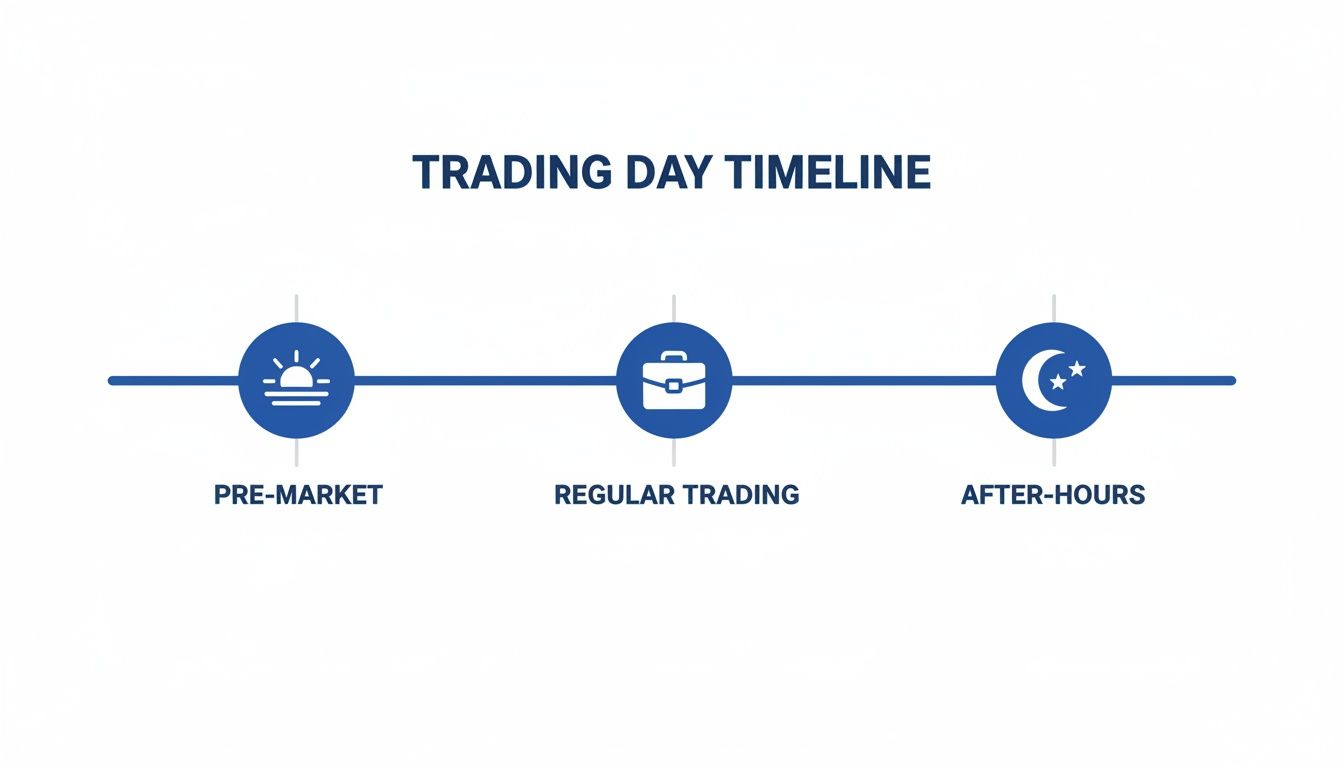
As you can see, the market doesn't just switch on and off. There are specific phases driven by different catalysts and populated by different players.
The Early Session: Pre-Market Trading
The action kicks off with pre-market trading, which generally runs from 4:00 AM to 9:30 AM ET. This is the market's dawn patrol, where the first reactions to overnight news start taking shape. It's when traders get their first coffee and catch up on everything that happened while the U.S. market was "asleep."
The biggest drivers of pre-market moves usually fall into a few buckets:
- Overnight Global News: A surprise economic report out of Europe or a major policy shift in Asia can easily set the tone for the entire U.S. session.
- Corporate Announcements: Companies sometimes drop significant news—think mergers, CEO changes, or FDA approvals—before the opening bell to get ahead of the day.
- Earnings Hangovers: If a company reported earnings after Tuesday's close, its stock will be actively traded all through Wednesday's pre-market as investors and analysts digest the numbers.
Because of this, pre-market activity offers some of the first real clues about market sentiment for the day. For a closer look at this session, check out our complete guide to pre-market trading and how to approach early market moves.
The Late Session: After-Hours Trading
Once the closing bell rings at 4:00 PM ET, the regular session is done, but the party is far from over. The action spills directly into after-hours trading, which runs from 4:00 PM to 8:00 PM ET. This is often the most dramatic part of the extended-hours window, driven almost entirely by one thing: corporate earnings reports.
The vast majority of U.S. public companies strategically release their quarterly earnings results after the market closes. This is done to give investors and analysts time to process the complex financial data without causing chaotic, knee-jerk price swings during the highly liquid regular session.
This timing turns the after-hours session into a hotbed of volatility. A great earnings report can send a stock soaring in minutes, while a miss can cause it to plummet. It's where you see the raw, initial reaction to a company's performance play out in real time.
The Engine Room: Electronic Communication Networks
So, how does any of this happen without the chaos of the New York Stock Exchange floor? The magic is all digital, powered by Electronic Communication Networks (ECNs). These networks are the invisible infrastructure that makes all extended-hours trading possible.
Think of an ECN as an automated matchmaker for buyers and sellers. Instead of routing through a traditional exchange middleman, these computerized systems directly connect buy and sell orders. If you place a limit order to buy 100 shares of XYZ at $50.05 after hours, the ECN instantly scans its network for someone willing to sell 100 shares at that exact price. If it finds a match, the trade executes.
This direct matching system is incredibly efficient. However, since fewer people are trading outside of regular hours, the pool of available orders is much smaller. This is the root cause of lower liquidity and wider spreads, and it's precisely why using the right order types—which we'll get into next—is non-negotiable for anyone trading in these sessions.
The Hidden Risks of Trading After the Bell
Sure, the chance to jump on breaking news is a huge draw, but trading outside the normal 9:30 AM to 4:00 PM ET window isn't for the faint of heart. This isn't just a quieter version of the regular market; it's a completely different arena with its own rules and some serious traps for the unprepared.
Wading into these sessions without knowing the landscape is like driving down a dark, unfamiliar road—you never know what hazard is lurking around the next corner. The three biggest risks you'll face are lower liquidity, wider spreads, and crazy volatility, and they're all tangled together.
The Problem of Lower Liquidity
Liquidity is the lifeblood of any healthy market. Think of it like a packed farmers' market at noon on a Saturday. Thousands of buyers and sellers are all competing, which makes it incredibly easy to find someone to buy your apples from or sell your tomatoes to at a fair price.
But in extended hours, that bustling market shrinks to just a few lonely stalls. With way fewer people around, finding a trading partner gets a lot tougher. This scarcity of players is what we call lower liquidity, and it’s the root cause of nearly every other after-hours headache. To get a better handle on this critical concept, check out our guide on market liquidity.
Wider Bid-Ask Spreads Will Cost You
This lack of liquidity immediately leads to another problem: much wider bid-ask spreads. The "bid" is the most a buyer will pay for a stock, and the "ask" is the least a seller will take. The gap between them is the spread.
- During regular hours: For a popular stock, fierce competition might shrink the spread to just a penny. (e.g., Bid: $100.00, Ask: $100.01).
- During extended hours: With hardly anyone trading, that same spread could blow out to something like this: (e.g., Bid: $99.85, Ask: $100.25).
That $0.40 spread is a direct, unavoidable cost baked into your trade. If you bought at the ask and had to sell at the bid a second later, you'd instantly lose money. Wider spreads are basically a tax on your transaction, making it more expensive to get in and out of a position.
A wide bid-ask spread is the market screaming at you that liquidity is thin and risk is high. Ignoring that warning is one of the fastest ways to bleed your account dry after the bell.
Navigating Extreme Volatility and Price Gaps
When trading volume is thin, even a single medium-sized order can send prices flying. Picture trying to drop a big rock into an Olympic-sized swimming pool versus a small puddle. In the pool (high liquidity), the water level barely budges. In the puddle (low liquidity), that same rock creates a massive splash.
This is exactly why volatility can be so extreme in extended hours. A buy order for just a few thousand shares—a drop in the bucket during the day—can cause a stock's price to spike dramatically. These moves are often deceptive because they don't reflect what the broader market is thinking.
Even worse, the prices you see after hours can be an illusion. A stock might close at $50, rocket to $55 in after-hours trading on tiny volume, only to open the next morning back at $51 once the full crowd of traders weighs in. When thinking about these risks, it’s also critical to consider the role of data latency and accuracy in financial information, as slow or bad data can make a bad situation worse.
The Non-Negotiable Rule: Always Use Limit Orders
Because of all these risks, using market orders during extended hours is just asking for trouble. A market order tells your broker to execute at whatever the best available price is. With low liquidity and huge spreads, that "best" price could be shockingly far from what you saw on your screen.
Instead, you absolutely must use limit orders. A limit order lets you set your price—the maximum you’ll pay to buy or the minimum you’ll accept to sell. If the market can't fill your order at your price or better, the trade simply won't happen. It's your single best defense against a catastrophic fill.
Actionable Strategies for Extended Hours Trading
Knowing the risks is one thing, but actually navigating the pre-market and after-hours sessions requires a solid game plan. Success here isn't about reacting to every little price flicker; it's about precision, discipline, and having a clear set of strategies.
Let's get practical. Most successful approaches boil down to two main types: trading predictable, scheduled events or reacting to sudden, unexpected news. Both capitalize on the thin liquidity of extended hours, where big news can create outsized price swings.
The Earnings Play Strategy
This is probably the most common after-hours trading strategy, and for good reason. The earnings play is all about trading a company's stock right after it drops its quarterly report. Since most companies release their numbers after the 4:00 PM ET bell, the after-hours session becomes the first battlefield for traders to react.
Here’s how it typically unfolds:
- Do Your Homework First: Before the numbers hit the wire, you need to know what Wall Street expects. What’s the consensus for revenue and earnings per share (EPS)? The market reaction isn’t about the raw numbers—it’s about the surprise. A huge beat or a shocking miss is what creates the big move.
- Analyze the Release Instantly: The second the report is out, compare the actual numbers to the estimates. A big beat on both top and bottom lines can send a stock flying. Just as important, if not more so, is the forward-looking guidance. A weak forecast can crush a stock even if the past quarter was great.
- Execute with Limit Orders Only: If you decide to pull the trigger, limit orders are your only friend. A stock can gap up 10% in a blink on a stellar report. If you use a market order, you're asking for a terrible fill price. Set a limit order at a price you've decided is a reasonable entry before you trade, protecting yourself from the initial chaos.
The News Catalyst Strategy
While earnings are on the calendar, the news catalyst strategy is about capitalizing on the unexpected. Think of things like a surprise merger announcement, a positive FDA ruling, a new product reveal, or a major geopolitical event. These can break at any time, and the extended-hours market is the first place you can act on them.
Imagine a biotech firm announces fantastic clinical trial results at 7:00 AM ET. That stock is almost guaranteed to surge in the pre-market. A prepared trader can get in on that move before the opening bell brings in the masses. The key is to act fast, but not recklessly. Verify the source and think through the real impact of the news before you jump in.
Extended-hours trading isn't just a race for speed; it's about correctly interpreting information under pressure. A headline might look amazing, but the details in the press release could tell a completely different story.
Essential Risk Management for Extended Hours
Your strategy is worthless if you don't manage your risk like a hawk. The low-liquidity environment makes the usual safety nets unreliable. You have to adapt.
First, know your entry and exit points before you even think about placing a trade. The emotional, fast-paced nature of after-hours action can lead to terrible, impulsive decisions. Define your absolute maximum entry price and your profit target ahead of time. This creates a logical framework that stops you from chasing a stock to the moon or holding a loser all the way down.
Second, never, ever chase parabolic spikes. A stock that rockets 20% on a handful of shares can collapse just as quickly. Those moves are often unstable and driven by a few aggressive buyers. A more disciplined approach is to let the initial firework show die down, see if a new support level forms, and then consider an entry.
Why Stop-Loss Orders Are a Trap
This is critical: traditional stop-loss orders are often useless or even dangerous in extended hours. A standard stop-loss converts to a market order once your price is hit. In a thin, gapping market, this can lead to catastrophic slippage, where your sell order executes miles below your stop price.
Because of this danger, many brokers won't even accept standard stop-loss orders for these sessions. The only real alternative is to watch your positions actively and use limit orders to get out. It demands more attention, but it gives you total control over your exit price—and in this environment, that control is non-negotiable.
Using ChartsWatcher for Extended Hours Insights
Theory is great, but trading is all about execution. If you're going to step into the pre-market or after-hours sessions, you need tools that can cut through the noise and show you what actually matters. This is where a platform like ChartsWatcher becomes your command center, turning abstract strategies into a concrete, actionable game plan.
Trying to trade these sessions without the right tools is like flying blind. Most standard charting packages don't even show extended-hours data by default, which means you're missing a huge part of the story. You're left vulnerable to a massive price gap at the opening bell—a gap that was clearly forming in the pre-market session you couldn't even see.
Here’s a perfect example of how much more you see when you just flip the switch on extended hours data.
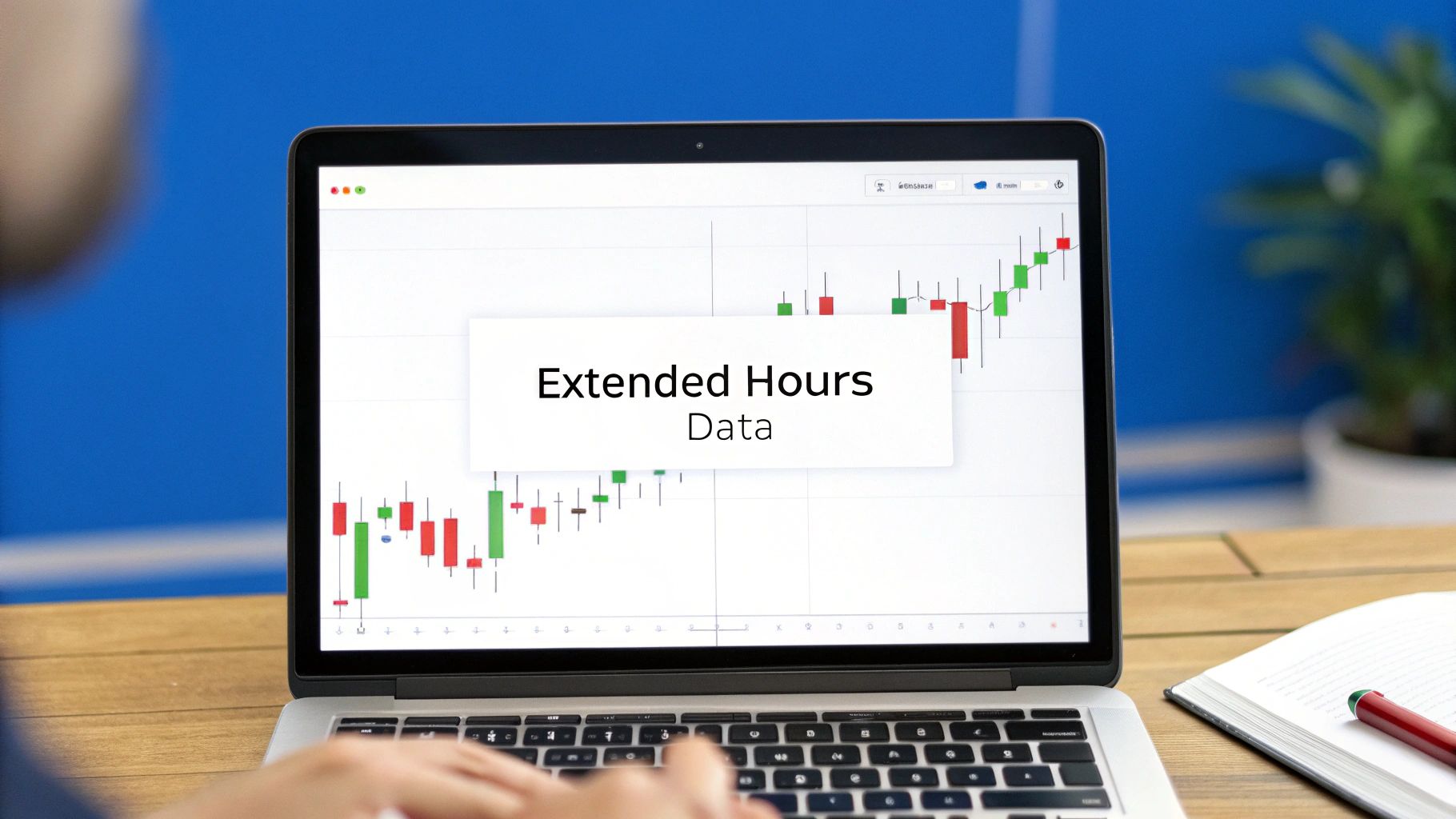
This image makes it obvious: crucial price action and volume spikes are happening well outside the standard 9:30 AM to 4:00 PM window. With default chart settings, all of that is completely invisible.
Enabling the Full Price Action Story
The very first, most critical step is to see the entire market—not just the 9-to-4 snapshot. In ChartsWatcher, you can easily toggle on the extended-hours data for your charts. It’s a simple click, but it immediately reveals the pre-market and after-hours price action, giving you the full context behind a stock's behavior.
This isn't just a nice-to-have feature; it’s fundamental. By visualizing this data, you can:
- Identify Pre-Market Gaps: Spot stocks gapping up or down on news before the market opens. This gives you precious time to form a plan.
- Analyze After-Hours Earnings Reactions: See the instant price reaction to an earnings release unfold in real-time on your chart, not just on a lagging news feed.
- Discover Key Support and Resistance Levels: Levels formed during these sessions are often incredibly significant. A pre-market high, for instance, can easily become a major resistance point during the regular session.
Setting Up Custom Alerts for Key Movements
You can’t be chained to your screen 24/7. That's not a sustainable strategy, especially when big moves can happen at 6:00 AM or 7:00 PM. This is where automated alerts become your eyes and ears on the market. With ChartsWatcher, you can set up highly specific alerts that only ping you when something truly important is happening.
For instance, you could create alerts for:
- Unusual Volume Surges: Get a notification if a stock trades over 500,000 shares in the pre-market—a clear signal of institutional interest.
- Price Threshold Breaks: Set an alert if a stock punches through its previous day's high during the after-hours session.
- Percentage Movers: Receive a ping if a stock rips more than 5% in either direction outside of regular trading hours.
These alerts give you the freedom to step away from the screen, confident that you won't miss a critical move. They deliver the signal directly to you, so you can spend your time on analysis and execution, not just staring at charts.
Finding Movers with the Stock Screener
So, how do you even find which stocks are active before the opening bell? Instead of manually flipping through a dozen watchlists, a powerful stock screener is the answer. The ChartsWatcher screener is built to pinpoint activity specifically within these less-liquid sessions.
You can build custom scans to find exactly the kind of setup you're hunting for. A common pre-market scan, for example, might look for:
- Stocks with a price greater than $5.
- Pre-market volume greater than 100,000 shares.
- Current price gapping up more than 3% from the previous close.
This type of focused screening instantly shrinks the universe of thousands of stocks down to a handful of actionable candidates showing unusual strength or weakness. It transforms your process from one of passive observation to active opportunity hunting.
By combining complete charting data, automated alerts, and a powerful screener, you build a systematic workflow for tackling what is extended hours trading. This approach helps you get ahead of the market instead of just reacting to it, empowering you to proactively identify and act on high-potential setups with far greater precision and confidence.
The Future of a 24-Hour Stock Market
Let's face it: the traditional 9:30 AM to 4:00 PM ET trading day feels like a relic from a bygone era. In a world of interconnected global economies and instant information, the U.S. markets are slowly but surely marching toward a near 24-hour, five-day-a-week model. This isn't some far-off theory; it's happening now, and it's going to completely reshape how traders and investors approach the market.
Heavyweights like the NYSE, Nasdaq, and CBOE are already deep in the planning stages for extending their hours. This massive shift is creating a new trading frontier where market access is nearly continuous, tearing down the time zone walls that used to segment financial activity around the globe.
A New Market Structure Is Taking Shape
This evolution is forcing a foundational rethink of the market's plumbing. The Securities Information Processors (SIPs)—the systems that consolidate and broadcast official market data—have already floated a plan to the SEC to operate almost around the clock. Their proposed window would run from 8:00 PM ET Sunday to 8:00 PM ET Friday, creating one unified data feed for a much longer trading day.
While the goal is to standardize operations across all trading venues, it brings up some tough questions for everyone involved:
- Market Safeguards: How do you adapt circuit breakers and volatility controls for an overnight session where liquidity is thin?
- Best Execution: What does "best execution" even mean for an order placed at 2:00 AM, when quotes might be few and far between?
- Regulatory Supervision: How will firms need to staff up and adjust their compliance systems to properly monitor trading activity 23 hours a day?
The move toward a 24-hour market isn't just about adding more hours to the clock. It's about rebuilding the underlying rules, risk management frameworks, and technological systems to support a truly global and continuous trading environment.
Final Thoughts on Your Trading Journey
As this guide has laid out, the world of extended-hours trading is one of clear opportunities shadowed by very real risks. As the market keeps evolving toward a 24-hour cycle, the core principles of discipline and caution become more important than ever. The goal isn't to be a reckless gambler in a volatile arena, but an educated participant who understands the landscape.
Before you even think about committing serious capital, start small. Use a paper trading account to test your strategies or trade with tiny position sizes to get a real feel for the environment without taking a major financial hit. This hands-on experience will teach you more about liquidity, spreads, and order execution than any article ever could. Go into these sessions with a solid plan, manage your risk like your life depends on it, and you'll be well-equipped for the future of trading.
Got Questions About Extended-Hours Trading?
Even after covering the basics, a few specific questions always pop up when traders first venture outside the 9:30 AM to 4:00 PM bell. Let's tackle some of the most common ones head-on to clear up any lingering confusion.
Are Pre-Market or After-Hours Better for Trading?
This is a classic question, but the truth is, neither session is inherently "better." It all boils down to your strategy and what kind of news you’re looking to trade.
The after-hours session (4:00 PM - 8:00 PM ET) is prime time for scheduled corporate earnings reports. If your edge is digging into financial results and predicting the market’s reaction, this is your playground. On the other hand, the pre-market session (4:00 AM - 9:30 AM ET) is all about reacting to overnight surprises—global news, economic data releases from other countries, or unexpected company announcements. Traders who focus on macro events tend to live here.
Do All Brokers Support Extended-Hours Trading?
Nope. It’s a common assumption, but not every broker is set up for it. While most of the big online brokerages give you access to both pre-market and after-hours, their rules can vary quite a bit. Some might offer a shorter window, like starting pre-market at 7:00 AM ET instead of the full session that begins at 4:00 AM.
Before you jump in, always double-check your broker’s specific policies on:
- Available Hours: Pinpoint their exact pre-market and after-hours trading windows.
- Order Types: The vast majority only allow limit orders. This isn't a limitation; it's a critical safety feature to protect you from wild price swings.
- Fees: It's rare, but some brokers might have a different fee structure for these sessions. Better to know upfront.
Is Getting My Order Filled a Sure Thing?
Absolutely not, and this is probably the most important lesson for a new extended-hours trader. During regular hours, the market is swimming with buyers and sellers. Outside of those hours, the pool gets much, much smaller.
This low liquidity means there simply might not be anyone on the other side of your trade at the price you want.
Orders placed in extended hours are filled on a best-effort basis. If the system can't find a matching buyer or seller for your limit order, your trade will sit there unfilled—even if you see the stock trading at other prices.
This is exactly why setting realistic limit orders based on the current bid-ask spread is so crucial. Don't chase a stock; let the price come to you.
Why Is It So Much More Volatile After the Bell?
It comes down to simple supply and demand in a very shallow market. With far fewer people trading, even a moderately sized order can move the price in a way that would be impossible during the regular session.
Think of it this way: a 10,000-share buy order that would barely make a ripple at 11:00 AM might cause a stock to spike dramatically after hours. Every order just has more impact.
Ready to stop guessing and start seeing what's really happening outside of regular market hours? ChartsWatcher gives you the professional-grade tools you need to see the complete picture. Enable extended-hours data on your charts, build custom pre-market scanners, and set alerts so you never miss an opportunity. Make your next move an informed one by visiting https://chartswatcher.com today.