
Insights from ChartsWatcher
What Are Market Makers and How Do They Shape the Market
At its core, a market maker is a firm or an individual that's always in the market, ready to play. They constantly quote two prices for a given security: a bid price (what they’ll pay to buy it from you) and an ask price (what they’ll charge to sell it to you).
Think of them as the wholesalers of the financial world. They’re the essential gears that keep the market engine running, ensuring you can instantly buy or sell an asset without having to wait around for another investor to show up on the other side of your trade.
The Hidden Engine of Financial Markets
Imagine a local farmer's market, but without a dedicated grocer. If you wanted an apple, you’d have to wander for hours hoping to find someone who happens to be selling one at that exact moment. The whole process would be slow, prices would be all over the place, and the market would feel chaotic.
That’s exactly the problem market makers solve in the financial world.
They are that reliable grocer, always at their stall, willing to buy and sell. By constantly offering to transact, they create a continuous, orderly market. This service is known as providing liquidity, and it’s their most critical job.
Market Makers at a Glance Key Roles and Functions
The presence of market makers brings direct benefits to everyone, from small retail traders to the largest institutions. Their entire role can be broken down into a few core responsibilities that keep the markets healthy.
This table summarizes their primary functions and the direct impact each has on the market's efficiency.
| Function | Description | Impact on the Market |
|---|---|---|
| Liquidity Provision | Constantly quoting buy (bid) and sell (ask) prices for a security. | Ensures traders can always execute orders quickly without causing significant price shifts. |
| Price Stability | Absorbing temporary imbalances in supply and demand. | Reduces short-term volatility and smooths out price fluctuations, creating a more orderly market. |
| Tighter Spreads | Competing with other market makers to offer the best prices. | Lowers transaction costs for all participants by narrowing the gap between the bid and ask prices. |
As you can see, their functions are interconnected, all working toward a more stable and accessible trading environment.
In essence, market makers create a fluid and dependable trading environment. Without them, the cost of trading would soar, and the confidence required to invest would diminish, making it far more difficult to participate in global finance.
How Market Makers Master the Bid-Ask Spread
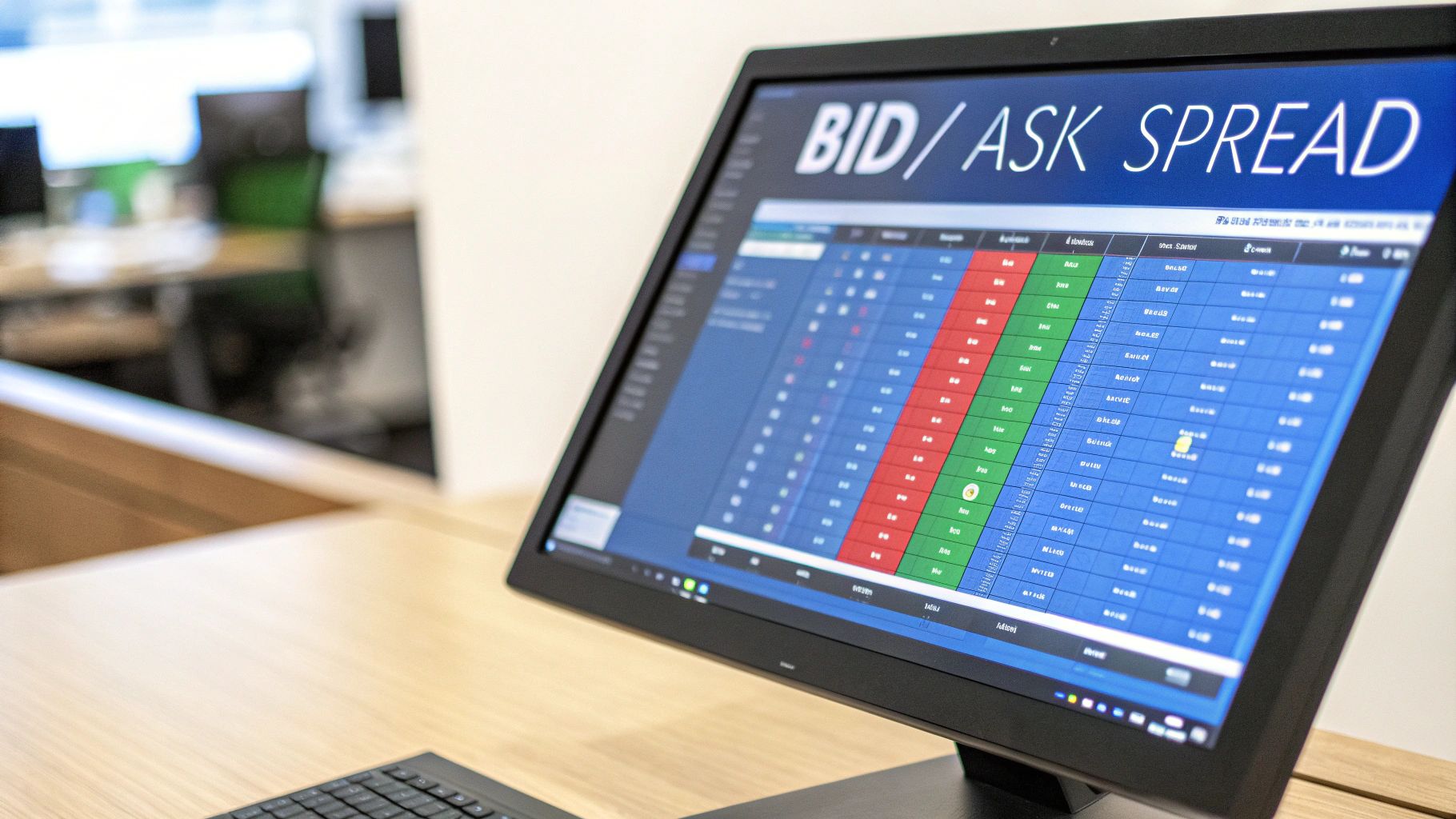
Market makers live and breathe at the center of the trading universe, and their entire business model hinges on one simple concept: the bid-ask spread. This is just the small gap between the price they’re willing to buy a security for (the bid) and the price they’re willing to sell it for (the ask).
Ever been to a currency exchange booth at the airport? They’ll buy your U.S. dollars at one price and sell them back at a slightly higher one. That tiny sliver of a difference, when multiplied by thousands of transactions, becomes their profit. Market makers do the exact same thing, but with stocks, bonds, or crypto, executing these trades thousands of times a second.
This spread isn’t just pure profit; it’s their compensation for taking on the huge risk of always standing ready to make a trade. The size of the spread changes based on how volatile or liquid an asset is, but the game is the same. For a deeper dive, check out our complete guide on the bid ask spread.
The Art of Managing Inventory
To constantly offer prices to both buyers and sellers, a market maker has to hold an inventory of the assets they trade. It’s a bit like a grocery store that needs to keep apples on its shelves. If a crowd of shoppers rushes in for apples, the store needs enough in stock to sell. If local farmers show up with a bumper crop, the store needs the space to buy and hold them.
Market makers manage this inventory with incredible precision. The ultimate goal is to stay relatively balanced, or what traders call a "flat" position.
- Buying too many shares from sellers without offloading them to buyers causes their inventory to swell. This leaves them exposed—if the stock price tanks, the value of their holdings goes down with it.
- Selling more shares than they buy shrinks their inventory and creates a "short" position. Now they're vulnerable to a price spike, as they’d have to buy back shares at a higher cost to cover their sales.
Juggling this requires some serious firepower. Market makers rely on advanced quantitative tools, and a firm grasp of current financial modeling best practices is non-negotiable for pricing risk and tweaking their inventory in real time. This is a high-stakes balancing act powered by immense computational muscle and slick algorithms.
A Real-World Transaction Example
Let's break it down with a popular stock, say Company XYZ, that’s trading around $100. A market maker might post their quotes like this:
- Bid Price: $99.99 (The price they will pay to buy shares from you)
- Ask Price: $100.01 (The price they will charge to sell shares to you)
The spread is a razor-thin $0.02. Now, a trader hits "sell" on 100 shares of XYZ. The market maker instantly snaps them up at their bid price of $99.99. A split-second later, another trader wants to buy 100 shares. The market maker sells their newly acquired inventory at the ask price of $100.01.
In that single, seamless transaction, the market maker pocketed $0.02 per share, for a total of $2.00. It sounds trivial, but they do this millions of times a day. Those tiny margins quickly add up to massive revenue.
Hedging Against Market Shocks
The biggest nightmare for a market maker is a sudden, violent price swing. If they're holding a ton of a stock that abruptly crashes, they're looking at catastrophic losses. To guard against this, they use sophisticated hedging strategies.
Hedging is simply taking an opposing position in a related asset. For example, if a market maker is long a large block of XYZ shares, they might simultaneously sell a futures contract on the S&P 500. If the whole market takes a nosedive, the losses on their XYZ stock could be cushioned by the profits from their short futures position.
This intricate dance of quoting, inventory management, and hedging is what allows market makers to provide continuous liquidity. They are essential intermediaries who handle immense trading volumes, ensuring markets function smoothly even during turbulent periods.
Their role is foundational to modern finance. In just the first five months of 2021, the U.S. equities market turned over an average of nearly $580 billion every single day—a volume that’s only manageable because of the liquidity these firms provide.
Why You Can't Have a Healthy Market Without Market Makers
Far from being simple middlemen, market makers are the absolute bedrock of modern financial markets. Their single most important job is to provide liquidity—the ability to buy or sell something fast without the trade itself wrecking the price. Think of it like the water level in a harbor; when it's deep (high liquidity), huge ships (big trades) can sail in and out without a problem.
Without that constant liquidity, markets would be more like shallow, rocky puddles. Every single trade would risk making massive waves, sending prices flying up or down unpredictably. Market makers are the ones who make sure the harbor is always deep enough for business to flow smoothly.
The Engine of Fair Price Discovery
This constant flow of liquidity is what makes price discovery possible. Price discovery is just the fancy term for the market figuring out what an asset is actually worth, based on the constant push and pull of buyers and sellers. Market makers sit right in the middle of this beautiful mess, absorbing the imbalances between supply and demand.
Their two-sided quotes act like a gravitational pull, keeping an asset's price tethered to its real value. When buyers rush in, the price drifts up; when sellers take over, it drifts down. The market maker ensures this is an orderly negotiation, not a chaotic free-for-all that would cause wild price swings and make trading more expensive for everyone.
By always being there to take the other side of a trade, market makers create a reliable and continuous market. This fosters the confidence investors need to participate, knowing they can get in or out of a position instantly at a fair price.
Market Makers Are the Market's Shock Absorbers
Beyond their day-to-day job, market makers play a vital role as shock absorbers when things get crazy. When panic selling kicks off, public buyers often vanish. A market maker, however, is obligated or incentivized to step in and start buying, soaking up the selling pressure and preventing a complete price meltdown.
The same thing happens in reverse during a buying frenzy. They provide shares to a hungry market, which helps cool off extreme upward spikes. This doesn't stop major market moves from happening, but it cushions the blow, slowing down rapid price changes and giving everyone a moment to breathe and process what's happening. That stabilizing effect is crucial for keeping the market from breaking.
Obligated vs. Independent Players
It's important to know that not all market makers play by the same rules. Their roles and responsibilities can be quite different, which changes how they contribute to the market's health.
-
Designated Market Makers (DMMs): Think of these as the specialists. Firms on exchanges like the New York Stock Exchange (NYSE) are contractually obligated to maintain a "fair and orderly market" in specific stocks. They have strict rules, like having to post quotes within a certain percentage of the last trade, which adds a powerful layer of stability.
-
Electronic Market Makers: These are often high-frequency trading (HFT) firms that provide liquidity across thousands of stocks on many different electronic exchanges. They aren't tied to one specific stock, but they compete like crazy on price. This fierce competition is what drives spreads down and makes trading cheaper for investors.
Both types are essential. DMMs are the mandated backstop, the stability crew. Electronic market makers, on the other hand, are all about driving efficiency and lowering costs through competition. The impact of having both is undeniable. If you look at historical market volume data from major U.S. exchanges, you'll see a clear link between the rise of electronic market making and a huge, sustained increase in trading volumes over the past decade-plus.
This setup is a direct win for the average investor. All that competition squeezes the bid-ask spread, saving you a little bit of money on every single trade. More importantly, it gives you the confidence that when you hit that "buy" or "sell" button, someone will be on the other side ready to fill your order in an instant—and that's the real foundation of a trustworthy market.
Identifying Market Maker Footprints on Your Charts
Knowing the theory behind market makers is one thing. Actually spotting their activity in real-time? That’s where the real edge is. When you can identify their footprints on your charts and in the order book, you start to see the hidden structures that drive price. It turns abstract concepts into actionable intelligence.
This means looking deeper than simple chart patterns and digging into the market’s microstructure. Market makers leave subtle clues, but they’re often buried in the flow of orders and volume data. Learning to read these signals is like learning to read the currents of a river; it shows you where the real power is moving just beneath the surface.
This diagram breaks down the essential roles market makers play in keeping the market ecosystem healthy.
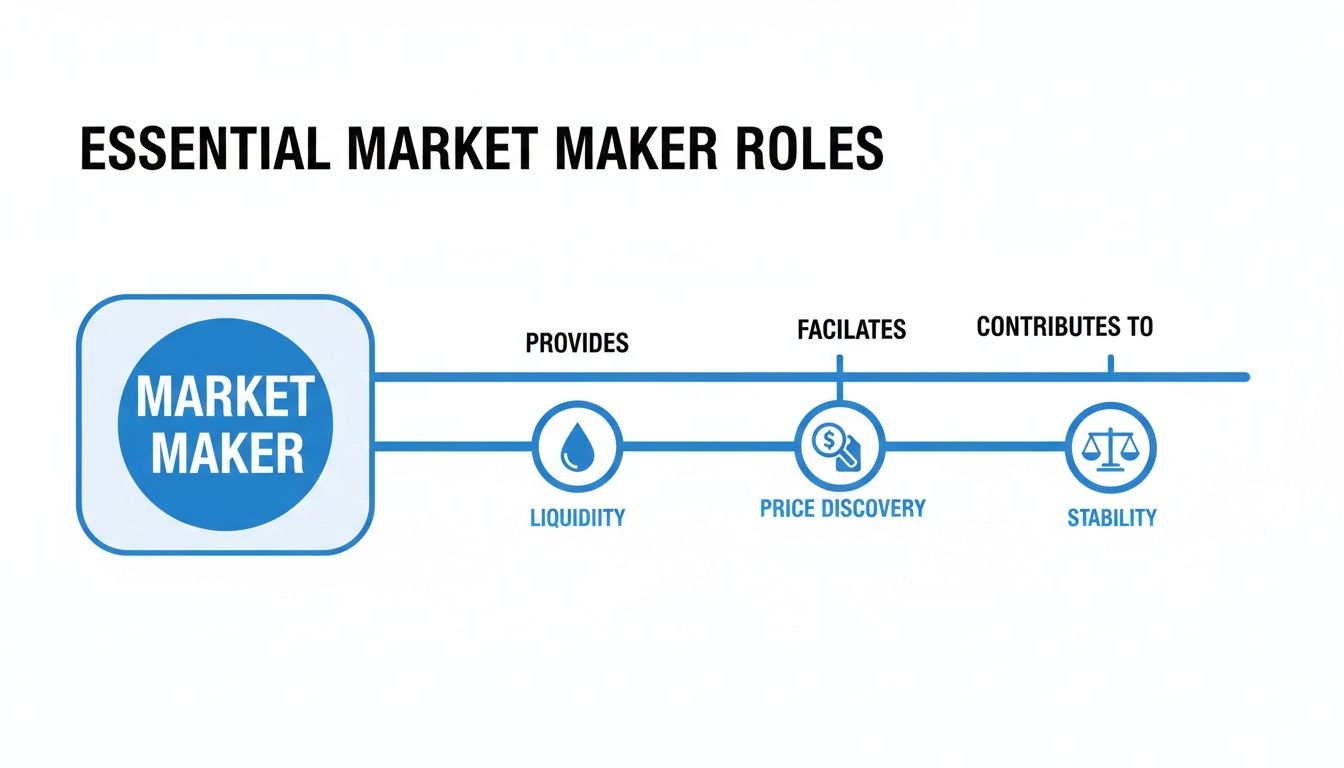
As you can see, their core functions—providing liquidity, aiding price discovery, and ensuring stability—are all deeply connected and fundamental to how a market operates efficiently.
Reading the Order Book for Clues
The order book, or Level 2 data, is your primary window into a market maker’s world. It can look like a chaotic flood of numbers, but certain patterns are dead giveaways of their presence. The key is to look for large, stationary orders that aren’t chasing the price.
See a massive bid order sitting several levels below the current price? That’s not there by accident. It's often a market maker signaling a major support level. They are basically telling the market, "We are willing to soak up a huge amount of selling pressure right here." The same goes for large ask orders, which act as formidable resistance. Our complete guide on how to read Level 2 data offers a deeper look into these mechanics.
These huge, static orders are often called "iceberg" orders. You only see the tip—a small fraction of the order is visible on the book, but a massive amount of hidden liquidity sits underneath, ready to absorb trades without causing a major price shock.
Uncovering Absorption in the Volume Profile
Analyzing the volume profile is another powerful technique. You want to hunt for areas where a massive amount of market orders are getting filled, yet the price barely budges. This is a classic footprint called absorption, and it’s the signature of a big passive player—usually a market maker—quietly doing their job.
Imagine a stock is tanking on heavy volume. Then, out of nowhere, the price hits a wall and starts churning in a tight range, even as the selling continues. This is a tell-tale sign that a large buyer is absorbing every sell order that comes their way, putting a floor under the price. It's a strong signal that a potential bottom is being formed, courtesy of a market maker managing their inventory.
Spotting Other Tell-Tale Signs
Beyond static orders and volume absorption, a few other behaviors can give away a market maker's game. Spotting them takes a sharp eye and a solid grasp of how these firms operate. To effectively identify their activity, it's essential to understand how advanced data analytics in financial services are used to decipher complex market data.
Here are a few more signals to keep on your radar:
- Consistent Spread Maintenance: Pay attention to how the bid-ask spread behaves. If it stays consistently tight and stable, even during periods of moderate volatility, that’s a good sign a dedicated market maker is actively managing the order book.
- "Spoofing" and Layering: Although illegal, spoofing happens. It involves placing large orders with zero intention of letting them execute. The goal is to create a false impression of supply or demand to bait other traders. If you see a monster order pop up and then vanish right as the price gets close, you may have just witnessed a spoof.
- Repetitive Small Orders: Sometimes, a large order is chopped up by an algorithm into hundreds of tiny, identical orders that are fired off rapidly. This is a way to build or unload a position without tipping their entire hand on the order book.
Recognizing these footprints gives you a much clearer map of the market's underlying dynamics. Instead of just reacting to price, you can start anticipating it based on the moves of the market's most influential players.
Trading Strategies That Leverage Market Maker Activity
Alright, so you can spot the footprints market makers leave behind. Now what? The real magic happens when you turn those observations into an actual trading edge.
This is about more than just reacting to a price tick. It's about anticipating the next move by understanding what the biggest players on the field are trying to accomplish. To do that, you need to look past the standard indicators everyone else is watching and dive into the market's underlying plumbing.
Building a strategy around market makers isn't some secret formula. It's about creating a systematic way to track their behavior, figure out what it means, and then act on it with conviction. By zeroing in on order flow, volume, and liquidity patterns, you can start positioning your trades alongside the market’s most dominant forces instead of getting run over by them.
Configure Intelligent Order Book Alerts
The order book is the battlefield, and market maker orders are the heavy artillery. Your first practical step is to set up smart alerts that tell you when something important is happening. Forget generic price alerts—those are lagging indicators. You need to be watching the liquidity itself.
Using a platform like ChartsWatcher, you can build alerts that are laser-focused on order book events. Think of these less as notifications and more as your personal early-warning system.
- Large Order Detection: Set an alert for when a new bid or ask pops up that’s bigger than a certain size, say, 50,000 shares. This is an instant flag that a major player might be setting up a new support or resistance level.
- Order Book Imbalance: Create an alert that fires when one side of the book suddenly gets much heavier than the other. A huge surge of bids can be a signal that a market maker is getting ready to soak up a wave of selling.
- "Pull" Notifications: This one is critical. You want an alert that triggers when a massive order is pulled from the book. If you see a giant bid vanish just before the price hits it, that was likely a spoof designed to trick traders. Knowing you just witnessed a fake-out is an incredibly powerful piece of intel.
These kinds of alerts cut through the noise of a fast-moving order book and give you clear, actionable signals. They let you react the moment a market maker shows their hand.
Use Advanced Volume and Order Flow Analysis
An alert tells you what just happened. Volume and order flow analysis helps you figure out why. These tools are what you use to confirm a market maker’s presence and get a real sense of their intentions.
For instance, absorption patterns—where you see a ton of volume hitting the bid but the price refuses to drop—are a classic sign that a large, passive player is quietly buying up everything sellers can throw at them.
You can use volume profile tools to see exactly where the real battles are being fought. If you see a massive volume shelf building at the same level where a big bid was sitting, that’s your confirmation. The market maker is actively defending that price, which gives you a whole new layer of confidence in your trade idea.
The scale of market maker influence is immense. The forex market alone sees a daily turnover of $6 trillion, and another $6 trillion in notional value trades daily across fixed income and futures—all of which rely on electronic liquidity providers. During the market chaos of March 2020, for example, NYSE Designated Market Makers proved their worth by ensuring their listed stocks had much tighter spreads than others, acting as a stabilizing force when it was needed most. You can learn more about the impact of market makers on global trading volumes on TradingEconomics.com.
Build Custom Dashboards to Monitor Signals
Market maker activity isn't just happening in one stock; it’s a market-wide phenomenon. A serious trader needs a command center to track these signals across multiple assets at once. This is where building a custom dashboard in a tool like ChartsWatcher becomes a non-negotiable part of your workflow.
A well-designed dashboard brings all your critical data points into a single view. You could have one window streaming real-time order book alerts, another showing a volume profile chart for your main watchlist, and a third running a scanner that flags unusual volume spikes across the market.
By putting all these tools together, you can spot correlated moves and identify sector-wide market maker activity, giving you a much richer understanding of the market’s true behavior.
Backtest Your Strategies to Validate Your Edge
An idea is just an idea until you’ve tested it. Before you risk a single dollar of real capital, it’s absolutely essential to backtest any strategy based on market maker signals. A solid backtesting engine lets you apply your alert configurations and entry/exit rules to historical market data.
This process gives you hard data to answer the most important questions: How often do these setups actually occur? What’s the historical win rate? What’s the real risk-to-reward ratio?
By running your strategy through months or even years of past data, you can fine-tune your parameters and build the confidence you need to execute without hesitation in a live market. Backtesting is what separates professional preparation from amateur guesswork—it turns a cool observation into a statistically validated trading plan.
The Risks and Regulations of Market Making
While market makers are the bedrock of a stable market, their role is anything but risk-free. They operate in a high-stakes arena, constantly juggling immense financial exposure while navigating a minefield of strict regulations. Seeing this side of the coin is key to understanding why their operations are so incredibly complex.
The most obvious danger is inventory risk. Think about it: a market maker might be holding millions of shares in a company that suddenly drops a bombshell of a bad earnings report. The stock price can evaporate in seconds, leaving them with catastrophic losses on their books before they can even think about offloading the position. They are paid to absorb these shocks, but the shocks can be brutal.
A more subtle but equally dangerous threat is adverse selection. This is the classic fear of being the “dumb money” at the table. It’s the risk of unknowingly trading with someone who knows something you don't—an insider, or a quant with a revolutionary new model. The market maker, who is obligated to post a quote, might end up buying a ton of shares moments before terrible news hits, or selling right before a huge positive announcement. They’ve essentially taken the uninformed side of a very informed trade.
The Regulatory Gauntlet
To keep the game fair and prevent the kind of chaos that can crash markets, market makers are wrapped in a dense web of rules from agencies like the Securities and Exchange Commission (SEC). This isn't just friendly oversight; it's a set of rigid guardrails designed to protect everyday investors and maintain the integrity of the market.
These regulations aren’t suggestions—they're hard lines that dictate every part of their business.
At its core, regulation is about balancing the market maker's drive for profit with their fundamental duty to create a fair and orderly market. It’s the system's way of making sure their powerful position isn’t abused.
Regulators are always on the hunt for manipulative behavior. Some of the most heavily policed activities include:
- Spoofing: This is when a trader places large, visible orders they have no intention of ever letting fill. The whole point is to create a fake sense of supply or demand to bait other traders into moving the price where they want it.
- Front-Running: This is trading on a tip-off from your own client’s order flow. If a firm sees a massive buy order coming from a pension fund, they can't legally jump in and buy shares for their own account first to ride the wave.
- Layering: A more sophisticated version of spoofing where a trader stacks multiple fake orders at different price levels to paint a completely misleading picture of market depth.
Getting caught can lead to astronomical fines and even criminal charges, as seen in recent high-profile enforcement actions by the Department of Justice targeting these exact practices. This constant scrutiny adds yet another layer of pressure. Juggling risk management, the hunt for profit, and a thick rulebook is the daily reality for every market maker.
Common Questions About Market Makers
Even after you get the basics down, a few common questions always pop up about how market makers really work. Let's tackle them head-on to clear up any confusion.
Are Market Makers the Same as Brokers?
Not at all—they play completely different roles. Think of a broker as an agent you hire. You give them an order, and they go out into the market to find a buyer or seller for you, executing the trade on your behalf.
A market maker, on the other hand, is a principal. They trade from their own inventory and often become the direct counterparty to your trade. When you sell, they buy from you. When you buy, they sell to you. Their profit comes from the bid-ask spread, not a commission.
Can Market Makers Manipulate Prices?
While their massive trading volumes definitely move the needle in the short term, outright manipulation is illegal and heavily regulated. Market makers aren't in the business of pushing a stock to some pre-determined price; their game is all about profiting from the spread while managing their inventory risk.
Things like "spoofing"—placing huge orders they have no intention of filling just to spook other traders—are strictly forbidden. Regulators like the SEC come down hard on that stuff. Plus, the intense competition between dozens of market-making firms creates a natural check on any single firm trying to rig the game.
The key thing to remember is that market makers win by facilitating massive volume and managing risk, not by cheating. Their influence on price is a side effect of providing liquidity, not a weapon for manipulation.
How Does High-Frequency Trading Fit In?
Today, most of the big market makers are high-frequency trading (HFT) firms. They use incredibly powerful computers and sophisticated algorithms to quote prices and manage risk across thousands of stocks at once, reacting to market shifts in millionths of a second.
This technology is what allows them to offer razor-thin bid-ask spreads and provide more liquidity than human traders ever could. HFT is just the modern-day toolkit for the age-old business of market making, and it's a big reason why trading costs have come down for everyone.
How Do Market Makers Work in Crypto and DeFi?
In the decentralized finance (DeFi) world, the role is often played by an Automated Market Maker (AMM). Instead of a big firm, an AMM is just a smart contract—a piece of code that lives on a blockchain.
AMMs use pools of crypto assets, supplied by users, to facilitate trades without a traditional order book. People who deposit their tokens into these "liquidity pools" are essentially acting as the collective market maker, and they earn trading fees for doing so. This is the engine that powers most decentralized exchanges (DEXs).
Ready to turn your understanding of market makers into a real trading advantage? With ChartsWatcher, you can build intelligent alerts, analyze order flow, and create custom dashboards to track their activity in real-time. Stop guessing and start seeing what the market's biggest players are doing. Explore the features and sign up today!