
Insights from ChartsWatcher
Unlocking Short Interest to Float as a Trading Tool
Think of it like this: you're at a brand-new stage play, but a huge chunk of the audience is already betting it's going to be a total flop before the final curtain call. That, in a nutshell, is what short interest to float tells you about a stock. It’s a powerful way to gauge market sentiment, showing you just how many traders are actively betting against a company.
What Short Interest to Float Reveals About a Stock

At its heart, short interest to float is a simple ratio that measures collective pessimism. It pits the number of shares sold short (bets the price will drop) against the total number of shares actually available for trading (the float). The result is a percentage that acts as a real-time sentiment meter for a stock.
Forget dry, academic definitions. This is a signal flare on the market battlefield. A low percentage might mean traders are feeling pretty good, or at least aren't bothered. But when that number starts to creep up, it's a clear sign that a growing chorus of bears believes the stock is overvalued or heading for trouble.
A Double-Edged Sword
A high short interest to float is one of the most fascinating signals in trading because it cuts both ways.
On one hand, it's a massive red flag. It tells you a significant group of traders—who are often well-informed and highly motivated—are convinced the stock's price is going down. Their reasons could be anything from:
- Rotten Fundamentals: They might see revenues tanking, weak profits, or a mountain of debt.
- Industry Headwinds: The company could be stuck in a dying sector or getting crushed by competitors.
- Absurd Valuation: The stock price might have shot up way beyond what the company's performance can justify.
But here’s the flip side, and this is where it gets exciting. A heavily shorted stock is like a coiled spring. All it takes is one piece of unexpected good news—a blowout earnings report, a game-changing product, a surprise contract—to light a fire under it. This good news forces short sellers to scramble, buying back shares to close out their losing bets before the damage gets worse.
This frantic buying from panicked short sellers is what we call a short squeeze. It can cause a stock's price to go absolutely parabolic in a very short amount of time. This explosive potential is exactly why stocks with high short interest are constantly on the radar for traders hunting for high-volatility plays.
Understanding this dual nature is key. The short interest to float doesn't just tell you a stock is disliked; it shows you that it's under intense pressure. That pressure can either crush the stock, just as the bears predicted, or it can ignite an explosive rally if they're proven wrong. It turns a simple percentage into a dynamic map of risk and potential reward.
How To Find and Calculate the Short Interest Ratio
Calculating the short interest to float is actually simpler than it sounds. You just need two key numbers and some basic division, but the result gives you a powerful snapshot of market sentiment.
Once you know where to look and what the numbers mean, you can quickly size up the bearish pressure on any stock.
The formula itself is clean and direct:
Short Interest to Float = (Total Shares Sold Short / Public Float) x 100
This gives you a percentage, telling you exactly what portion of a company’s tradable shares are currently tied up in bets against the stock. To make it work, you first need to find the two main ingredients.
Sourcing Your Data
Finding reliable data is the most critical part of this whole process. Plenty of financial sites offer these numbers, but how fresh that data is can make all the difference.
- Total Shares Sold Short: This is the running total of shares that have been borrowed and sold but haven't been bought back to close the position. Exchanges like the NYSE and NASDAQ only report this data twice a month.
- Public Float: These are all the shares of a company actually available for trading on the open market. It strips out shares held by insiders, major institutions, or governments—shares that aren't really in play day-to-day.
You can find these figures on most major financial news portals (think Yahoo Finance or MarketWatch), inside your brokerage platform's research tools, or on specialized market data services.
But here's the catch: the official exchange data comes out only twice a month, which creates a huge lag. For traders who need to react quickly, that’s an eternity. For a much more current view, platforms like ORTEX offer intra-day short interest estimates by aggregating data directly from lenders and brokers. This gives you a look at what’s happening now, not two weeks ago. You can see examples of their real-time data at public.ortex.com.
Here’s a look at the kind of detailed short data you can get from a specialized platform.
This dashboard goes way beyond just the short interest percentage. It includes other vital metrics like days to cover and the cost to borrow, giving you a much richer picture for your analysis.
A Practical Calculation Example
Let's walk through a quick example to make this concrete. We'll use a fictional company, "Momentum Motors Inc. (MMI)".
First, we need to gather our two data points:
- Total Shares Sold Short: After checking our data source, we find 15 million shares of MMI have been sold short.
- Public Float: The company has a public float of 75 million shares.
Now, we just plug these numbers into our formula:
Short Interest to Float = (15,000,000 / 75,000,000) x 100
Short Interest to Float = 0.20 x 100
The result is a short interest to float of 20%. This simple math instantly tells us that a full fifth of all tradable MMI shares are being used by traders betting the price will drop. That’s a pretty significant number, flagging high bearish sentiment and putting the stock squarely on our watchlist for a potential short squeeze.
Interpreting What the Short Interest Numbers Mean
So you’ve got the short interest to float percentage. That’s a powerful piece of data, but a number by itself is just noise. The real magic happens when you know how to interpret it, turning that raw figure into a trading edge.
Think of it as a market pessimism meter. The higher the number, the more traders are betting that the stock is going down. Understanding the different levels is like a doctor checking vital signs—it helps you quickly gauge the health and risk profile of a stock.
This simple formula is the key.
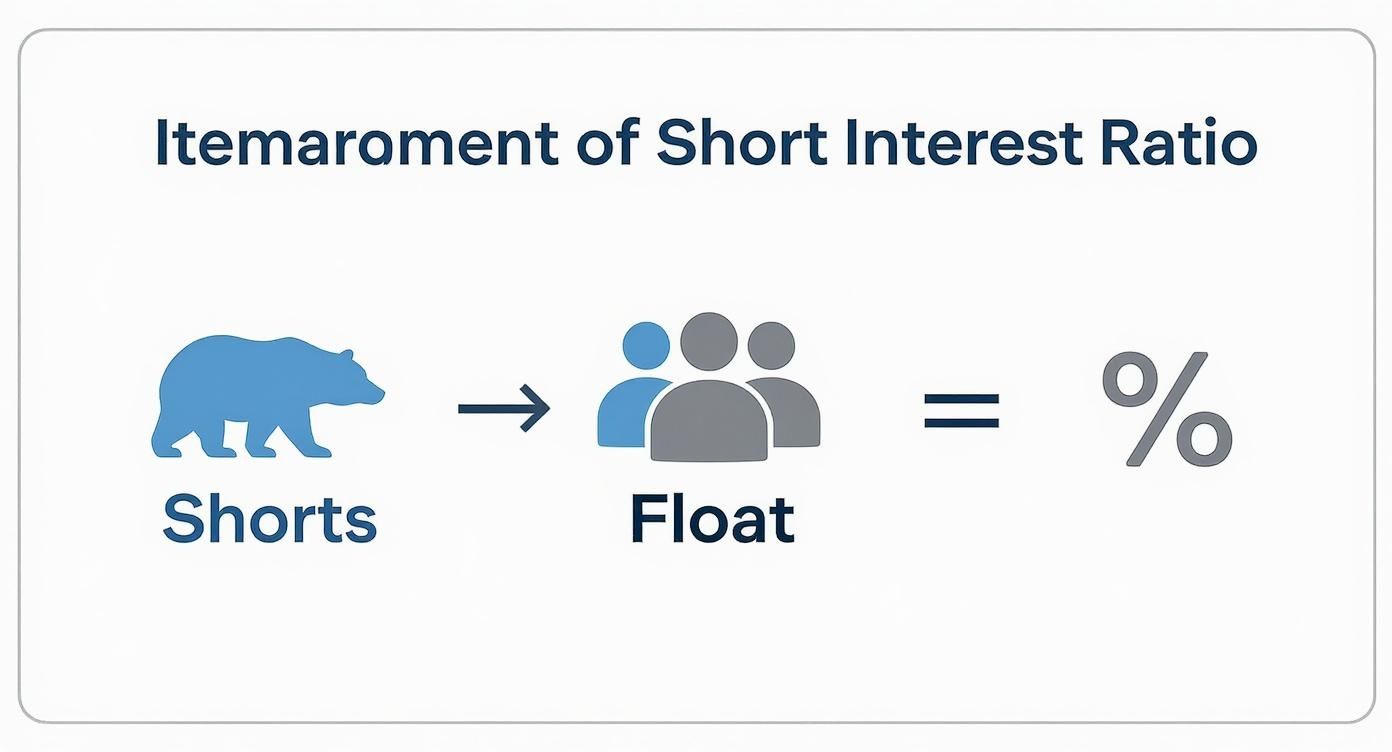
It’s all about weighing the number of shares shorted against the number of shares available for public trading. That ratio tells you everything you need to know about bearish sentiment.
Low Short Interest: Below 10 Percent
A short interest to float below 10% is pretty standard. This tells you there isn't any significant, organized pressure from short sellers. It’s business as usual.
Most traders see this as a neutral-to-positive sign. While it certainly doesn't guarantee the stock will go up, it means there's no major headwind from bears. Stocks in this range are almost never candidates for a short squeeze because there just isn't enough fuel to light the fire.
Moderate Short Interest: Between 10 and 20 Percent
When the ratio climbs into the 10% to 20% range, it’s time to start paying attention. This is a clear signal that a good chunk of the market thinks the stock is overvalued or has some serious problems on the horizon. It’s not a five-alarm fire, but it's definitely a yellow flag.
At this level, the stock is on a lot of traders' watchlists. The bearish sentiment is strong enough that you need to dig deeper. Why are so many people betting against it? Is a bad earnings report coming up? Are competitors eating their lunch? A moderate short interest often comes right before a big move—up or down.
High Short Interest: Above 20 Percent
A short interest to float above 20% is a massive red flag. This signals extreme pessimism. When over a fifth of a company’s tradable shares are in the hands of short sellers, it means there's widespread conviction that the price is headed for a cliff.
A stock with short interest over 20% is like a powder keg. While the bears are firmly in control, any piece of unexpected good news could trigger an explosive short squeeze. This forces shorts to buy back their shares in a panic, sending the stock price vertical.
This is the territory where legendary short squeezes are born. The high number of short sellers creates what's known as a "crowded trade." If good news hits, the stampede for the exits can be spectacular. The more shorts there are, the more fuel is available to power a rally if the bears get it wrong. For context, a company like Global-e Online (GLBE) once had a short interest of 5.95% of its float, which is on the lower end of what you'd watch. You can track this kind of data on financial sites like MarketBeat.com.
To make this easier, here's a quick reference guide for interpreting these levels on the fly.
Short Interest to Float Interpretation Guide
| Short Interest Level | Market Sentiment | Potential Implication |
|---|---|---|
| Below 10% | Neutral / Low Bearishness | Low risk of a short squeeze. Seen as normal market conditions. |
| 10% - 20% | Elevated / Growing Bearishness | Demands closer inspection. The stock could be volatile. |
| Above 20% | Extreme / High Bearishness | High risk for short sellers. A prime candidate for a short squeeze. |
Ultimately, interpreting the short interest to float is about understanding the conflict happening in the market. It’s a tug-of-war between the bulls and the bears, and this number tells you who might be pulling harder. By knowing what these different thresholds mean, you can better manage your risk and spot some truly unique opportunities.
Integrating Short Interest Into Your Trading Strategy
Knowing the theory is one thing, but actually using short interest to float to make trading decisions is where the rubber meets the road. This metric isn't just some abstract number; it's a dynamic tool that can be the backbone of some seriously powerful trading strategies. When you know how to use it, it can help you pinpoint unique opportunities, whether you're looking to go long or short.
Let's shift from theory to action and break down two distinct strategies. Each one uses the short interest ratio as a core ingredient, but for completely different reasons. One is all about hunting for explosive moves to the upside, while the other uses it to add conviction to a bearish play.
Strategy 1: Hunting for Short Squeeze Candidates
This is, without a doubt, the most popular way traders use high short interest, and for good reason. The goal here is to find stocks where a huge number of short sellers are piled into a crowded trade, setting the stage for a violent, fast-moving spike in price.
But a high short interest to float is only the first ingredient. A true squeeze needs a catalyst to light the fuse.
Here’s the blueprint for finding these setups:
- Step 1: Identify High Short Interest: Your first move is to scan for stocks with a short interest to float above 20%. This is the non-negotiable starting point that tells you a stock is heavily bet against.
- Step 2: Find a Powerful Catalyst: A high short interest alone is just a tinder box waiting for a spark. You need to find a trigger that could panic shorts into covering their positions. Look for upcoming events like earnings reports, new product launches, clinical trial results, or major partnership announcements.
- Step 3: Confirm with Technicals: Finally, look for technical signs that the stock is trying to put in a bottom or is already showing bullish momentum. This could be a breakout above a key resistance level, a classic bullish chart pattern forming, or a noticeable surge in trading volume.
A short squeeze erupts when a stock's price jumps unexpectedly, forcing short sellers to scramble to buy back shares to close their positions and cut their losses. You can learn more about the mechanics in our complete guide on what a short squeeze in stocks is. This frantic buying creates a feedback loop, launching the price even higher.
Let's walk through a practical example to see how this comes together.
Example: "Innovate Robotics (INRB)"
- The Setup: You find that INRB has a sky-high short interest to float of 28%. The company has been hammered due to production delays, which has attracted a ton of short sellers.
- The Catalyst: You see on the calendar that INRB is set to report quarterly earnings next week. On top of that, rumors are swirling about a game-changing partnership with a major corporation.
- The Entry Point: Looking at the chart, you notice INRB's stock has been trading sideways but is now breaking above its 50-day moving average on a big spike in volume. This technical strength, combined with the heavy short interest and the upcoming earnings report, makes for a compelling long entry.
- Risk Management: To protect yourself if the earnings news is bad, you place a stop-loss order just below the recent consolidation range.
Strategy 2: Confirming a Bearish Thesis
On the flip side, you can use a high short interest to float to validate your own bearish research. If your fundamental analysis screams that a company is in trouble, seeing a high short interest acts as a powerful confirmation from the rest of the market. It shows that other informed traders see the same red flags you do.
This approach isn't about timing a squeeze; it's about adding conviction to a fundamental short position.
Historically, stocks with a massive short interest have been ticking time bombs of volatility. A great example from late 2025 was Guzman y Gomez Limited (GYG), which had a staggering short interest of 34.65% of its float. When nearly a third of a company's available shares are sold short, it often reflects deep-seated operational or financial problems, giving you a strong signal that bearish sentiment is well-founded. You can dig into more historical short interest data over at Fintel.io.
Example: "Legacy Retailers (LRT)"
- Fundamental Analysis: Your research shows that LRT is getting crushed by online competitors. Their revenues are falling, profit margins are shrinking, and they're carrying a mountain of debt. Your conclusion: the stock is way overvalued.
- The Confirmation Signal: You pull up the data and find LRT has a short interest to float of 22%. This is your confirmation. It tells you that a significant chunk of the market agrees with your bearish view, which adds a ton of confidence to your trade idea.
- The Entry Point: Instead of shorting right away, you wait for a technical breakdown, like the stock price cracking below a major support level, before you initiate a short position.
- Risk Management: You set a buy-stop order above a recent high. This protects you from catastrophic losses if an unexpected positive catalyst, like a surprise buyout offer, sends the stock soaring.
By using short interest to float in these structured ways, you can transform it from a simple data point into a powerful cornerstone of your trading decisions.
Looking Beyond the Ratio with Complementary Metrics
Relying solely on short interest to float is like trying to navigate a ship with only a compass. Sure, it tells you which way sentiment is pointing, but it won't tell you the speed of the current or how close you are to the rocks. A high ratio is a powerful signal, but it’s just one clue in a much larger detective story.
To make well-rounded, high-conviction trading decisions, you have to pair this metric with other crucial data points. Think of it as building a case; the more corroborating evidence you have, the stronger your thesis becomes. These complementary metrics provide the essential context that the main ratio lacks.
By looking at the complete picture, you can better distinguish between a genuine short squeeze candidate and a fundamentally broken company that short sellers are rightly targeting. This multi-faceted analysis is what separates hopeful speculation from a well-planned strategy.
Days to Cover: The Real Squeeze Pressure
The first essential partner metric is Days to Cover, sometimes called the short interest ratio. If short interest to float tells you how many bears are in the room, Days to Cover tells you how crowded the exit is. It’s a direct measure of the potential buying pressure if short sellers are forced to cover their positions.
The calculation is straightforward:
Days to Cover = Total Shares Sold Short / Average Daily Trading Volume
A low number, like 2, means short sellers could theoretically cover all their positions in just two days of average trading. That suggests less panic potential. But a high number—especially above 10—indicates it would take over two weeks for shorts to exit. This creates a far more precarious situation for them and a much more potent setup for a squeeze.
Cost to Borrow: The Price of Pessimism
Next up is the Cost to Borrow (CTB). This is simply the annualized interest rate short sellers must pay to borrow the shares they need to sell. For most big, liquid stocks, this fee is negligible, often sitting under 1%.
But for hard-to-borrow stocks—usually those with a small float and tons of short interest—this cost can absolutely skyrocket. When the CTB climbs to 20%, 50%, or even over 100%, it puts immense financial pressure on anyone holding a short position. High borrowing fees can act as a catalyst on their own, forcing shorts to cover simply because holding the trade becomes too expensive. A rapidly rising CTB is a massive red flag for bears.
Float Size: Why Scale Matters
Finally, don't forget the size of the float itself. This is a critical piece of the puzzle. A stock with a massive float of 500 million shares and 25% short interest is far less likely to squeeze than a stock with a tiny float of 5 million shares and the same 25% short interest. The sheer volume of available shares in a large-float stock makes it much easier for shorts to find shares to buy back and cover their positions.
- Low Float Stocks (Under 20 million shares): These are far more volatile and susceptible to squeezes. A small amount of buying pressure can have an outsized impact on the price.
- High Float Stocks (Over 100 million shares): These tend to be more liquid and stable. It takes a much larger, more sustained buying effort to move the price and trigger a squeeze.
Combining these three metrics gives you a much clearer view. A prime squeeze candidate will often have a high short interest to float, high days to cover, a rising cost to borrow, and a relatively small float. To go even deeper, check out our detailed guide on the short float percentage and its strategic uses. This comprehensive approach helps you gather all the clues before placing your trade.
Putting It All Together with a Practical Walkthrough
Theory is great, but the rubber really meets the road when you apply it in the market. Let's walk through how to turn these concepts into a repeatable process for finding high-potential trading opportunities using a real-world tool like the ChartsWatcher scanner.
This is how you go from just learning about a metric to actively hunting for the next big move. We’ll build a custom scan from scratch, designed specifically to find stocks with a dangerously high short interest to float.
Setting Up Your Custom Scan
First things first, we need to tell our scanner what we're looking for. This means filtering the entire market down to a manageable list of stocks that fit our squeeze criteria.
- Select the Primary Filter: In your scanner's settings, the first metric you'll add is "Short Interest % of Float." This is the foundation of our entire search.
- Set Your Threshold: Configure the filter to show stocks with a short interest greater than (>) 20%. This single step instantly isolates stocks feeling extreme bearish pressure—the key ingredient for a potential squeeze.
This initial filter gives you a list of heavily shorted stocks, but it’s still a bit noisy. A high short interest is necessary, but it's not sufficient on its own. Now we need to add a few more layers to improve the quality of our results.
Refining Your Search with Secondary Filters
Let's add a couple more critical filters to weed out the low-quality setups and focus only on stocks with genuine explosive potential.
- Minimum Average Volume: Add a filter for "Average Volume (3 Month)" and set it to greater than 500,000 shares. This is crucial. It ensures we’re only looking at stocks with enough liquidity to support a significant price run-up and allow for clean entries and exits.
- Price Range: To filter out the wild west of penny stocks and the slower-moving, high-priced giants, add a "Price" filter. A solid starting point is between $5 and $100. This keeps our focus on established, mid-range companies.
Here’s what these filters look like when plugged into a professional scanning tool like ChartsWatcher.

This setup is now perfectly dialed in to find stocks that are not just heavily shorted, but also have the trading volume and price stability that make them viable candidates for a trade.
Key Takeaway: The goal isn't just finding high short interest; it's about finding quality setups. Combining the short interest to float metric with volume and price filters is the most effective way to separate the signal from the noise and build a high-potential watchlist.
Common Questions About Short Interest
As you start working with short interest in your trading, a few questions always pop up. Getting these sorted out is key to using the data correctly and not falling into common traps. Let's walk through the most frequent ones.
How Often Is Short Interest Data Updated?
This is probably the biggest "gotcha" for new traders. Officially, the big exchanges like the NYSE and NASDAQ only release short interest to float data twice a month. That means the numbers you see on most free financial sites can be ancient history—up to two weeks old. In trading, two weeks is an eternity.
This is where specialized data providers come in. Services like ORTEX or S3 Partners don't wait for the official reports. They gather data directly from prime brokers and stock lending agents to provide much fresher, often daily, estimates of short interest.
While the official exchange data is the final word, these daily estimates are what serious traders use. They bridge the gap and give you a much more current read on what short sellers are actually doing now, not two weeks ago.
Is High Short Interest Always a Buy Signal?
Absolutely not. This is one of the most dangerous assumptions you can make.
High short interest simply tells you a stock is heavily bet against. It means the potential for a short squeeze exists, but it doesn't guarantee one will happen. Think of high short interest as a room full of gasoline fumes. It’s highly flammable, but nothing happens without a spark.
That spark is the catalyst. Without a catalyst—a surprise earnings beat, positive clinical trial results, a big contract win—a heavily shorted stock can just keep bleeding out. If the bears are right about the company's weak fundamentals, the stock will just drift lower, and no squeeze will ever materialize.
Can I Rely Solely on This Metric for Trading?
Relying on any single indicator is a recipe for disaster, and short interest is no exception. It’s a powerful tool for gauging sentiment, but it tells you absolutely nothing about a company's financial health, its valuation, or whether its business is fundamentally sound.
To build a robust strategy, you have to look at the bigger picture.
- Fundamental Analysis: Dig into the company's books. Is revenue growing? Are they profitable? How much debt are they carrying? This helps you understand why the stock is being shorted in the first place.
- Technical Analysis: Look at the chart. Where are the key support and resistance levels? Is trading volume picking up? Technicals are crucial for timing your entries and exits.
- Complementary Metrics: Never look at short interest in a vacuum. Always check the Days to Cover, the Cost to Borrow, and the float size. These metrics give you the full context of the pressure building on short sellers.
Combining these layers of analysis is how you turn short interest from a simple number into a powerful component of a winning trade plan.
Ready to stop relying on outdated data and start building professional-grade scans? ChartsWatcher provides the real-time data and advanced filtering you need to find high-potential setups before the crowd. Customize your dashboard and build the exact scanner you need to elevate your trading. Explore our powerful tools at https://chartswatcher.com.