
Insights from ChartsWatcher
Define Buy to Cover Explained for Traders
When you short a stock, you're essentially betting against it. But every short trade has to end, and that's where the buy to cover order comes in. It's the command you give your broker to close out your short position by buying back the shares you initially borrowed and sold.
The whole point is to buy them back at a lower price than you sold them for, locking in your profit. Think of it as the second half—and mandatory final step—of every short-selling play.
What Does Buy to Cover Mean in Trading?
To get a real feel for what a buy to cover order does, let's use a simple analogy. Imagine you borrow a rare comic book from a friend, convinced its value is about to tank. You immediately sell that comic for $100.
A few weeks go by, and just as you predicted, the market price for that comic drops to $70. You jump on the opportunity, buy an identical copy for $70, and hand it back to your friend. That $30 difference? That’s your profit.
In this scenario, the act of buying the comic for $70 to return it is exactly what a "buy to cover" order does in the stock market.
A buy to cover order isn't about opening a new long position or making a fresh investment. It is strictly an exit command. Its only job is to close an existing short position by repurchasing the exact number of shares you originally borrowed.
The Role in Short Selling
This order is the essential trigger that officially ends a short sale. Until you execute it, your trade is still live, you're still "short" the stock, and you're still exposed to market movements. The profit or loss on your position is only realized the moment your buy to cover order is filled.
To put it all together, here’s a quick overview of how a short trade unfolds from start to finish.
The Short Selling Lifecycle At a Glance
The entire process, from borrowing shares to finally covering your position, can be broken down into four distinct stages. Each step is critical to successfully executing a short trade.
| Stage | Action Taken by the Trader | Objective |
|---|---|---|
| 1. Borrow | The trader borrows shares of a stock they believe will fall in price from their broker's inventory. | Secure the shares needed to initiate the short sale. |
| 2. Sell to Open | The trader immediately sells these borrowed shares on the open market, receiving cash in their account. | Establish the short position at the highest possible price. |
| 3. Wait | The trader monitors the stock, waiting for its price to decline as anticipated. | Allow the trade thesis to play out and create a potential profit margin. |
| 4. Buy to Cover | The trader places a buy to cover order to repurchase the exact number of shares previously sold. | Close the position, return the borrowed shares to the lender, and lock in the profit or loss. |
Ultimately, this lifecycle shows that short selling flips the traditional investing mantra on its head. Instead of the classic "buy low, sell high," the goal here is to sell high, then buy low.
How a Buy to Cover Order Actually Works
Okay, let's move from theory to the trading floor. Executing a buy to cover order is the final, decisive step in your short trade. It’s the concrete action you take to repurchase the shares you initially borrowed and sold, squaring up with your broker and locking in your result.
The entire process is handled by your brokerage. Once you hit that button, your broker finds and buys the shares on the open market at the current price. Those shares are then instantly returned to the lender who fronted them to you in the first place. Your trade is officially closed.
This is the exact moment your profit or loss is realized. It’s simply the difference between the high price you sold at and the low price you (hopefully) bought back at.
The Profit and Loss Calculation
Let's walk through a quick example to make this crystal clear.
Imagine you believe shares of Company XYZ, currently trading at $50, are headed for a fall. You decide to short the stock, borrowing shares and selling them at the market price.
The math is straightforward. If you borrow and sell 1,000 shares of a stock at $20 per share, you pocket $20,000 in cash. A few weeks later, the stock drops to $15. You place a buy to cover order, repurchasing those 1,000 shares for just $15,000. The transaction closes, and you're left with a $5,000 profit before commissions and fees. You can find more details on this profit mechanism from expert trading resources.
This is the core of short selling: profiting from a decline in price.
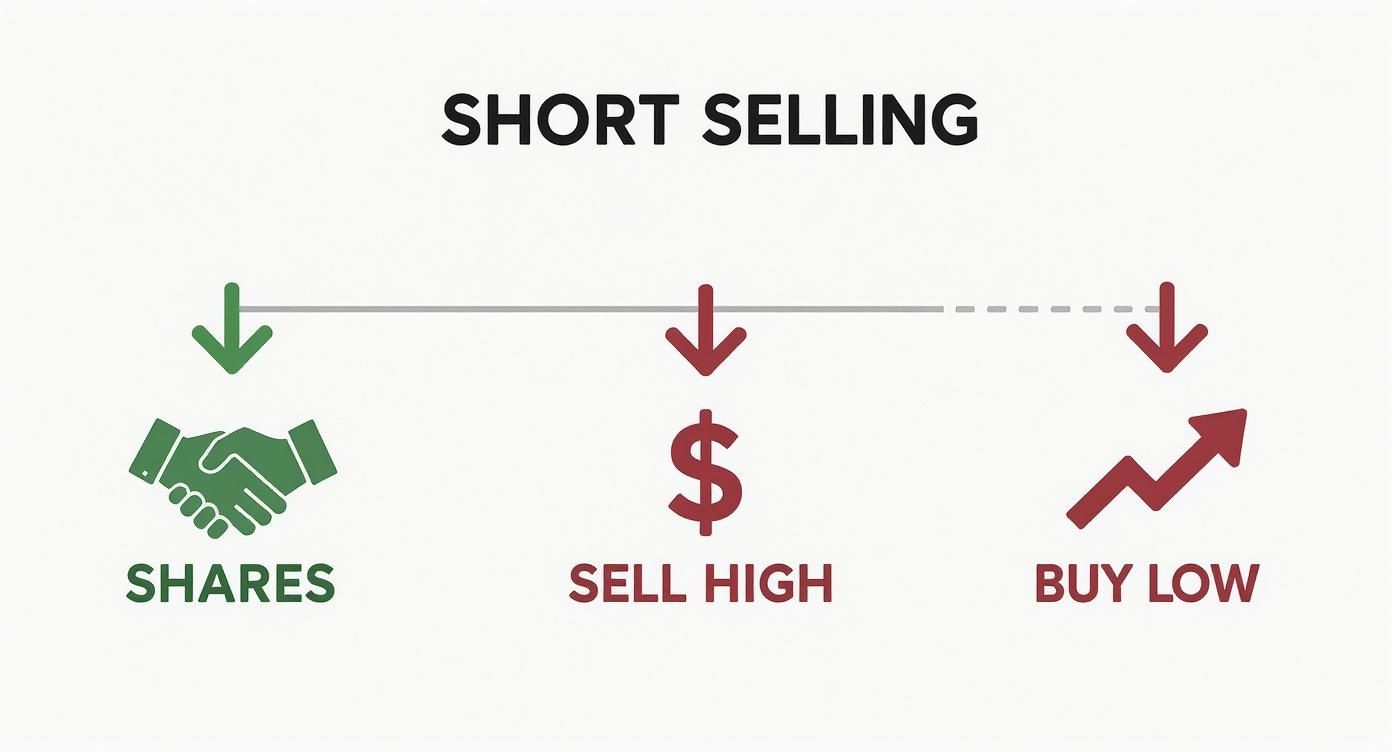
As you can see, the buy to cover order is the final, money-making (or losing) step in the sequence. It’s the action that completes the "sell high, buy low" cycle, turning your bearish thesis into a tangible result.
Choosing Your Buy to Cover Order Type

Alright, so you’ve decided it’s time to close out your short position. Now comes a critical choice: how do you place the order? You have two main tools in your arsenal—a market order or a limit order.
The one you pick can seriously impact your trade's outcome, especially when the market gets choppy. It boils down to a classic trading dilemma: speed versus control.
Think of it like trying to snag tickets for a sold-out concert. A market order is like screaming "buy now!" at whatever the scalper is asking. You're guaranteed to get in, but you might pay more than you wanted. A limit order is like telling your friend, "I'll only pay $100, not a penny more." You get the price you want, but you might end up missing the show entirely.
Market Orders for Speed
A buy to cover market order is your express lane out of a short position. You're essentially telling your broker, "Get me out of this trade right now at the best price available." The biggest advantage here is guaranteed execution. Your order will almost certainly get filled in a matter of seconds.
But that speed can cost you. The risk is something traders call price slippage. In a fast-moving stock, the price you actually pay to buy back the shares might be higher than the price you saw on your screen when you hit the button. For traders looking to lock in a small profit, even a few cents of slippage can turn a winning trade into a loser.
Limit Orders for Control
On the flip side, a buy to cover limit order puts you firmly in the driver's seat on price. With this order, you set the maximum price you are willing to pay to buy back the shares. Your order will only get filled if the stock's price hits your target level or drops even lower.
The catch? There’s absolutely no guarantee your order will execute. If the stock’s price takes off and never comes back down to your limit, your short position stays open. This leaves you exposed to potentially unlimited losses if the stock continues to rally against you.
Deciding between these two is a fundamental trading skill. It's a trade-off that every trader faces, and you can dig deeper into the nuances of a market order vs limit order for smarter trades in our detailed guide.
Choosing the right order type is about aligning your execution with your trading goals. Let's break down the direct comparison.
Market Order vs Limit Order for Buying to Cover
| Feature | Buy to Cover Market Order | Buy to Cover Limit Order |
|---|---|---|
| Execution | Guaranteed and nearly instant. | Not guaranteed. Only fills at your price or better. |
| Price | Uncertain. You get the next available price, which can lead to slippage. | Certain. You control the maximum price you'll pay. |
| Best For | Getting out of a position quickly, especially in volatile markets or when a trend is reversing fast. | Protecting profits or entering at a specific target price. Best for less volatile stocks. |
| Primary Risk | Slippage. Paying a higher price than anticipated, which can eat into your profits. | Partial or no fill. The price may never reach your limit, leaving you in the trade. |
Ultimately, the decision comes down to your immediate priority. If you absolutely need to exit a position to stop a loss or lock in a profit before it vanishes, the market order is your go-to tool. But if protecting your target exit price is the most important thing, a limit order gives you the control you need.
Understanding Short Selling Risks and Short Squeezes
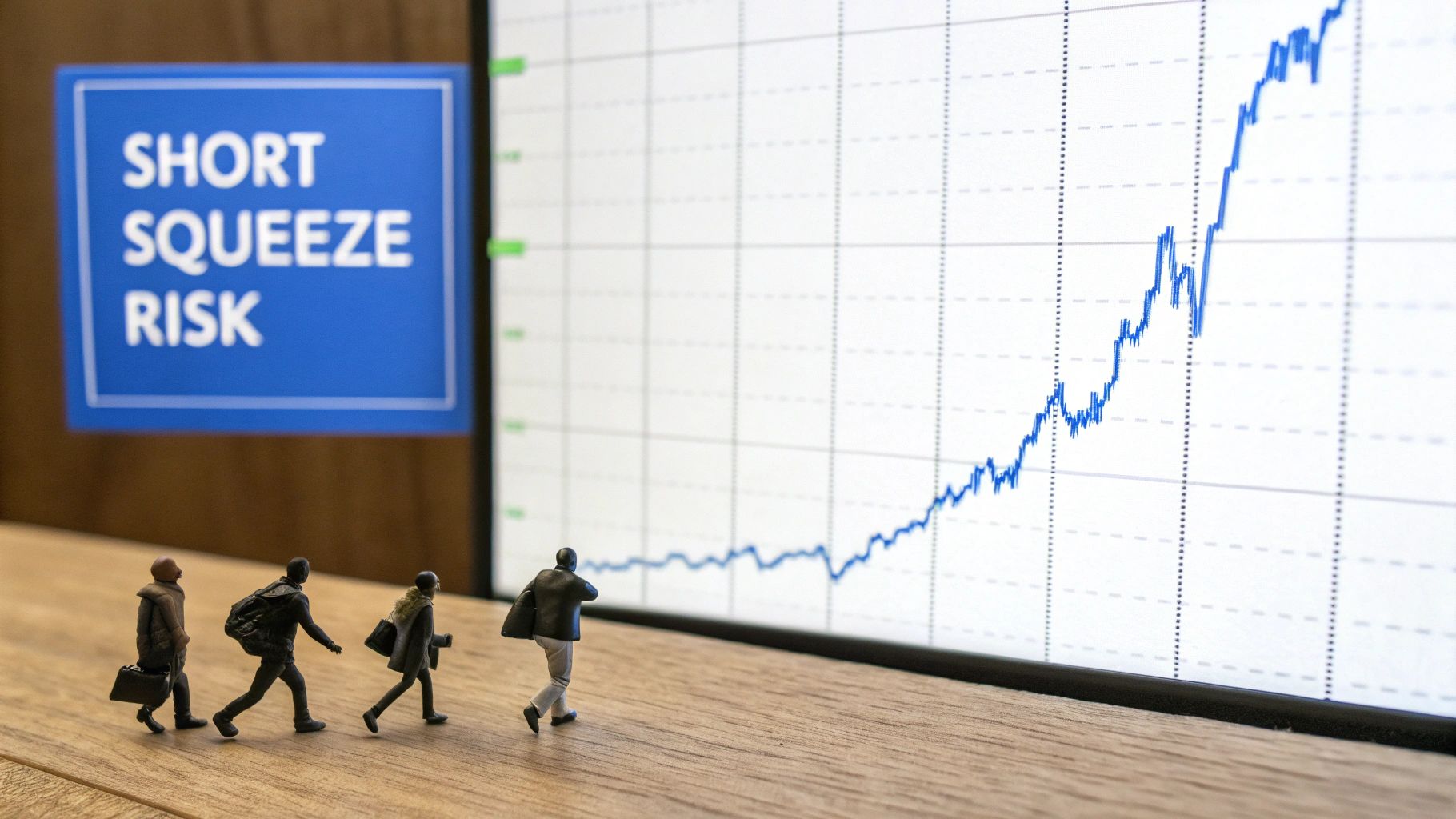 Short selling flips the script on traditional investing, but this high-reward strategy comes with some serious risks. Unlike buying a stock, where your maximum loss is just what you paid for it, a short position has theoretically unlimited loss potential. If the stock just keeps climbing, so do your losses.
The most infamous risk short sellers face is the dreaded short squeeze. Think of a crowded theater with only one tiny exit. Suddenly, the fire alarm blares. Everyone panics and stampedes for that single door, creating a chaotic jam. That's a short squeeze in a nutshell.
A sharp, unexpected spike in a stock's price is the fire alarm, forcing panicked short sellers to scramble for the exit by placing buy to cover orders. This sudden flood of buying only throws gasoline on the fire, rocketing the price even higher and creating a vicious cycle for anyone still holding a short position.
The Mechanics of a Squeeze
When short sellers rush to close their positions all at once, the intense buying pressure creates a feeding frenzy. They're all forced to execute buy to cover trades at worse and worse prices. We've seen events where frantic short covering contributed to price explosions of over 150% in just a few days. This shows just how powerful these orders are.
It’s a brutal reminder of the core danger of shorting. For a deep dive into how these situations unfold, check out our complete guide on what a short squeeze in stocks is and how to spot the warning signs.
Other Critical Dangers to Consider
Beyond a full-blown squeeze, short sellers have to navigate a minefield of other risks that can wreck a perfectly good trade. You absolutely have to keep these on your radar.
- Margin Calls: As the stock rises against you, the equity in your margin account shrinks. If it dips below your broker's maintenance level, you'll get a margin call. That means you either have to deposit more cash immediately or your broker will liquidate your position for you, locking in a loss.
- Borrowing Costs (Hard-to-Borrow Fees): Remember, you're paying interest on the shares you borrowed. For heavily shorted or "hard-to-borrow" stocks, these fees can get incredibly expensive and eat away at your potential profits, especially if the trade drags on.
- Forced Buy-in (Share Recall): The person who originally lent you the shares can ask for them back at any time. If that happens, your broker has no choice but to force you to buy to cover your position, whether it's a good time for you or not. It's completely out of your control.
Strategic Tips for Timing Your Buy to Cover Orders
Successfully closing a short trade isn’t about luck. It's about having a clear, disciplined exit plan before you even click the button. Pro traders don't guess when to buy to cover; they use a mix of technical analysis, hard rules, and market awareness to time their exits.
The foundation of a good exit strategy is actually built before you enter the trade. This means defining your non-negotiable profit targets and, just as importantly, your stop-loss levels. A stop-loss is simply a pre-set price where you'll automatically buy to cover, preventing a small, manageable loss from spiraling into a catastrophic one.
Using Technical Analysis to Find Exit Points
Technical analysis gives you a roadmap for identifying potential exit zones. Smart traders are always looking for specific chart patterns or levels where a stock's downward trend might run out of steam, signaling it’s time to take profits off the table.
Here are a few common tools traders use to time a buy to cover order:
- Support Levels: These are historical price points where a stock has consistently found buyers and bounced. When a stock you're shorting approaches a strong support level, it's a classic signal to consider covering.
- Moving Averages: A stock's price crossing back above a key moving average, like the 50-day or 200-day, can be a red flag. It often indicates that the momentum is shifting from bearish back to bullish.
- Reversal Patterns: Classic chart patterns like a "double bottom" or an "inverse head and shoulders" are visual cues that sellers are losing control and the buyers are starting to step in.
The most critical part of any trading plan is having the discipline to actually follow it. Fear and greed will tempt you to abandon your strategy, but sticking to your pre-defined exit points is what separates consistent traders from gamblers.
Reading the Room and Sticking to Your Plan
Beyond the charts, you have to pay attention to market sentiment and news. A surprise earnings beat, a positive industry announcement, or any unexpected good news can instantly blow up your bearish thesis and send a stock soaring. Staying aware of these potential catalysts helps you avoid getting caught on the wrong side of a sudden rally.
Ultimately, your success hinges on discipline. Once you've set your profit target and your stop-loss, you have to honor them. Don't let greed convince you to hold out for just a little more profit, and definitely don't let hope stop you from cutting a losing trade. A professional mindset means executing your plan, even when it’s emotionally tough.
Got Questions About Buying to Cover?
Even after you get the hang of short selling, a few practical questions almost always pop up when it's time to close a position. Let's clear up some of the most common ones so you can trade with more confidence.
Think of these as the real-world footnotes to the textbook definitions.
What’s the Difference Between Buy to Cover and Sell to Close?
This is a big one, but it's simple: they are polar opposites, used for completely different scenarios.
- A buy to cover order is what you use to get out of a short position. You’re buying back the shares you borrowed earlier to return them to the lender. It's the final step of a bearish trade.
- A sell to close order is for getting out of a long position. This is when you sell shares you actually own. It’s the classic “sell high” part of a traditional trade.
One is for closing out bets that a stock will fall, and the other is for cashing in on bets that a stock will rise.
Can My Buy to Cover Order Be Rejected?
Yes, it can happen, though it's not an everyday thing. The most common reason an order doesn't go through is self-inflicted: you set a buy to cover limit order, but the stock's price never drops to your target. If the stock rips higher instead, your order just sits there, unfilled, leaving your short position dangerously open.
In rare situations, like insane market volatility or a stock with very little trading volume, even a market order might have trouble executing. More often, a flat-out rejection points to an issue with your account, like not having enough funds to meet a margin call, which can restrict you from placing any new orders.
It's crucial to know the difference between a rejected order and an unfilled one. An unfilled limit order is a calculated risk you take for better pricing. A rejection, on the other hand, is usually a red flag about your account's standing or extreme market conditions.
How Long Can I Hold a Short Position Before I Have to Cover?
In theory, you can hold a short position forever, but there are some major strings attached. First and foremost, you have to maintain the required equity in your margin account. If the trade goes against you and your account value dips below the broker's threshold, you'll get a margin call forcing you to either add more cash or cover the position immediately.
Don't forget the costs, either. You're paying borrowing fees (or interest) on those shorted shares for every single day the position is open. And finally, there's always the risk that the person who lent you the shares wants them back. This is called a "share recall," and it can force you to buy to cover at a terrible time, profit or not.
Does a Buy to Cover Order Affect the Stock Price?
Absolutely. At the end of the day, every buy to cover order is simply a buy order. It adds demand for the stock, plain and simple. While one retail trader's order isn't going to move a giant stock like Apple, the collective force of many orders certainly can.
This is exactly what fuels a short squeeze. When a stock starts rising, panicked short sellers rush for the exits all at once. Their flood of buy to cover orders creates a massive spike in demand, which can send the stock price rocketing upward in a dramatic feedback loop. It's a powerful reminder of how much market impact these orders can have when they happen at scale.
ChartsWatcher provides the advanced scanning and real-time data tools professional traders need to identify opportunities and manage risk effectively. Track critical market movements, set precise alerts, and build a trading dashboard that fits your strategy. Explore the full suite of features at ChartsWatcher.