
Insights from ChartsWatcher
A Trader's Guide to Extended Trading Hours
When the closing bell rings at 4:00 PM in New York, the trading day is far from over.
For a long time, what happened outside the core 9:30 AM to 4:00 PM ET session was the exclusive playground of big institutions. But that’s changed. We’re now living in a world of pre-market (before the open) and after-hours (after the close) trading, and it's a core opportunity for any serious trader.
Trading Beyond the Bell is the New Reality
The idea of a rigid trading day is quickly becoming a relic. The market is fundamentally shifting towards a nearly continuous 24/5 environment, where the action doesn't stop just because the sun goes down on Wall Street.
This isn't happening by accident. It's a massive shift driven by some powerful forces.
The Forces Driving the Change
The push for a longer trading day is a perfect storm of technology, investor demand, and a shrinking globe. Here’s what’s really behind it:
- A Truly Global Market: Economies are more connected than ever. Major news that can rock U.S. stocks can break at any hour, and traders in Asia or Europe can't afford to wait until the next morning to react.
- The Rise of the Active Trader: A new generation of retail traders is here, and they aren't tied to a 9-to-5 desk. They want the flexibility to trade on their own schedule and, more importantly, to act on news like earnings reports the second they drop.
- Technology That Keeps Up: The digital plumbing of the financial world has gotten incredibly robust. Exchanges and brokers now have the infrastructure to handle trades securely and efficiently around the clock.
This isn't just a trend; it's a structural evolution. Regulators are getting on board, with the U.S. Securities and Exchange Commission (SEC) greenlighting plans for exchanges to dramatically extend their hours. The end goal is a 23x5 model—trading 23 hours a day, five days a week.
Sure, right now, over 90% of U.S. stock volume is still crammed into regular hours. But as the infrastructure gets better and more traders get access, that number is going to change. Fast. You can get a deeper dive into this push for round-the-clock trading on computershare.com.
This isn't just about adding a few more hours to the clock. It's a fundamental change in how markets work. Getting a handle on extended-hours trading is no longer just a nice-to-have skill—it's essential for keeping your edge.
This guide is built to be your playbook for this new 24/5 world. We’re going to break down the actionable insights and strategies you need to turn these extra hours into your advantage.
Understanding the Unique Market Dynamics
Think of the regular market as a bustling, multi-lane superhighway packed with cars, trucks, and buses. The traffic flow is immense, orderly, and pretty predictable. Extended trading hours, on the other hand, are like a quiet country road late at night—you might be able to move faster, but the journey is far less predictable and comes with its own set of hazards.
The very structure of the market—its microstructure—changes dramatically outside of the standard 9:30 AM to 4:00 PM ET session. Three key elements are at the heart of this transformation: liquidity, bid-ask spreads, and volatility. Getting a handle on how these factors interact isn't just an academic exercise; it’s absolutely essential for survival and success when you're trading outside the bell.
This infographic breaks down the core components of the trading day, showing you the pre-market, standard, and after-hours sessions at a glance.
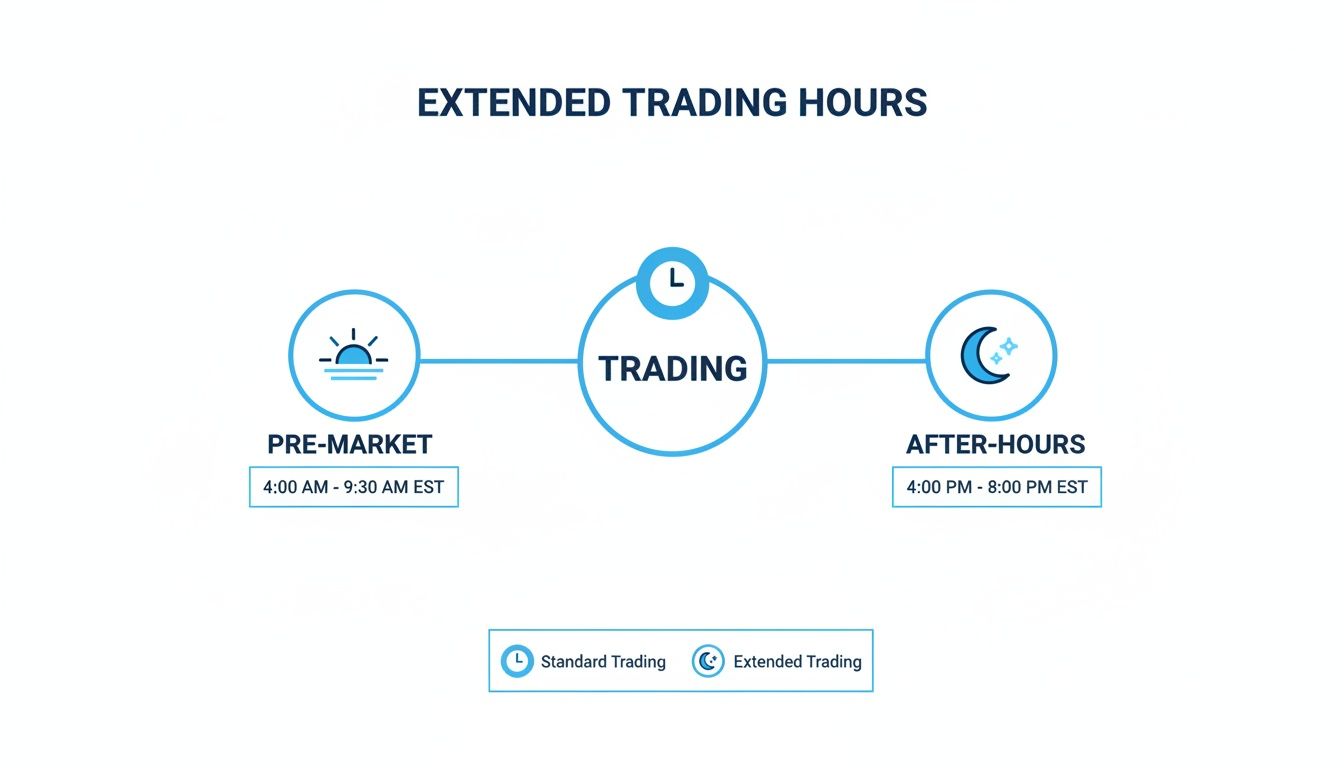
As you can see, these extended sessions bracket the main trading day. They are distinct periods where the market's personality shifts entirely, mostly because there are just fewer people at the party.
The Challenge of Thin Liquidity
Liquidity is the lifeblood of any market. It’s simply the ease with which you can buy or sell an asset without knocking its price out of whack. During regular hours, liquidity is sky-high because millions of participants—from giant pension funds to individual day traders—are actively placing orders. There’s almost always someone on the other side of your trade, ready to take your position.
But during extended trading hours, this all changes. Many of the largest institutional players are on the sidelines, waiting for the opening bell. The result is thin liquidity, which means fewer buyers and sellers are in the market. This creates a much more fragile environment where even a moderately sized order can have an outsized impact on a stock's price.
You can dive deeper into these early market dynamics in our complete guide to pre-market trading.
Why Bid-Ask Spreads Widen
A direct consequence of low liquidity is a wider bid-ask spread. The spread is simply the difference between the highest price a buyer is willing to pay for a stock (the bid) and the lowest price a seller is willing to accept (the ask).
- During regular hours: With tons of competition, spreads are often razor-thin—sometimes just a single penny.
- During extended hours: With fewer players, there's less competition to shrink this gap. Market makers, who help facilitate trading, demand a higher premium for taking on the risk of operating in a less liquid environment, causing the spread to widen.
A wider spread is an immediate, tangible cost to you as a trader. It means you're buying at a slightly higher price and selling at a slightly lower price. For active traders, this can seriously eat into profitability.
Volatility: The Double-Edged Sword
Volatility, or the rate at which a stock's price swings, often spikes during extended trading hours. This is the "faster travel, more hazards" part of our country road analogy. The main driver here is news. Major company announcements, like earnings reports or merger news, are frequently released right after the market closes.
With fewer participants online to absorb the initial reaction, these news events can trigger dramatic and rapid price moves. This heightened volatility is where the opportunity lies, but it also carries immense risk. A stock might gap up significantly on good news, but it could just as easily reverse course once the full market weighs in at the 9:30 AM open.
A case study from the London Stock Exchange really drives this point home. When they extended their hours, it led to a 6% drop in traded value and a massive 28.1% increase in bid-ask spreads—a clear signal of declining market quality.
To get a clearer picture, let's compare these two environments side-by-side.
Comparing Regular Hours vs. Extended Trading Hours
This table provides a side-by-side comparison of the key market characteristics during standard and extended trading sessions to highlight the differences traders must account for.
| Market Characteristic | Regular Trading Hours (9:30 AM - 4:00 PM ET) | Extended Trading Hours (Pre-Market & After-Hours) |
|---|---|---|
| Liquidity | High; millions of participants ensure deep order books. | Low; fewer institutional and retail traders are active. |
| Bid-Ask Spreads | Narrow; high competition keeps spreads tight (often pennies). | Wide; lower competition and higher risk lead to larger spreads. |
| Volatility | Generally lower, but can spike on intraday news. | Higher; prices are more sensitive to news and small orders. |
| Participation | Broad; includes institutional funds, market makers, and retail. | Limited; primarily retail traders and electronic networks. |
| Price Discovery | Efficient; large volume helps establish consensus prices quickly. | Less efficient; prices can be erratic and may not reflect true value. |
| Order Execution | Fast and reliable, with a high probability of being filled. | Slower and less certain; partial or no fills are more common. |
As the table shows, trading outside the main session is a completely different ballgame. The risks are higher, the costs are greater, and the environment is far less forgiving. Understanding these differences is the first step toward navigating the pre-market and after-hours sessions effectively.
Weighing the Opportunities and the Risks
Diving into the pre-market and after-hours sessions can feel like discovering a hidden level in a video game you thought you'd mastered. The rules are different, the potential rewards are higher, but so are the dangers lurking around every corner. To trade these sessions well, you need a clear-eyed view of this high-stakes environment, carefully balancing the incredible potential against some very real risks.
The main attraction is simple: you get to act on information before almost everyone else. When a company drops its quarterly earnings report at 4:05 PM ET, the after-hours session is the first battlefield where traders react. This gives you a shot at grabbing a position based on the news before the tidal wave of volume hits at the next day's opening bell.
Likewise, major geopolitical events or economic data released overnight can spark immediate moves in the pre-market. For traders who do their homework, these sessions offer a chance to get way ahead of the curve.
The Upside of Early Access
The opportunities in extended hours are compelling, particularly if you're a trader who thrives on news. The benefits really boil down to speed and getting into a strategic position before the herd arrives.
Here’s a quick breakdown of the main advantages:
- Reacting to Earnings Reports: Most companies release their earnings outside of the 9:30-to-4:00 window. This lets you trade the initial, often powerful, knee-jerk reaction to good or bad news.
- Capitalizing on Global News: A huge market-moving event in Asia or Europe can have a direct ripple effect on U.S. stocks. The pre-market is your first opportunity to respond.
- Convenience and Flexibility: Let's face it, the standard 9:30 AM to 4:00 PM ET trading day doesn't work for everyone. Extended hours open the door for people with regular day jobs to actively trade.
Let's look at a classic example. A tech company reports blockbuster earnings after the market closes, crushing analyst estimates across the board. In the after-hours session, its stock might immediately surge 15%. A trader who quickly analyzes the report and acts can ride that initial wave, hoping to profit from the "gap up" when the market officially opens the next morning.
The Dangers of the Low-Volume Environment
While the opportunities are real, the risks are just as potent. Don't ignore them. The very same thin liquidity that creates those dramatic price swings also introduces a minefield of dangers for the unprepared. Think of it as driving on an icy road—one wrong move, and you can easily spin out of control.
These are the main risks you have to manage:
- Low Liquidity and Slippage: With fewer buyers and sellers, your order might not get filled at the price you see on the screen. That difference, known as slippage, can be a costly surprise.
- Wider Bid-Ask Spreads: As we've covered, the gap between the buying and selling price widens considerably. This acts like a hidden tax on every single trade, putting you at an immediate disadvantage.
- Heightened Volatility: Prices can whip around violently on just a handful of shares, leading to false breakouts and sudden, gut-wrenching reversals. What looks like a strong trend can completely evaporate in minutes.
- Increased Competition from Professionals: Even though the overall volume is lower, you're often trading against sophisticated institutional traders and algorithms that are built specifically for this environment.
The price you see during extended trading hours is not always the 'true' price. It's a temporary consensus among a small group of participants and can change dramatically once the full market opens.
Now, imagine the flip side of our earnings example. A stock starts rallying hard in the pre-market based on a vague rumor. A trader sees the move and jumps in, chasing the breakout. But the rally is built on a foundation of sand—very low volume. It has no real conviction.
The moment the opening bell rings, institutional sellers step in with heavy volume, and the stock immediately reverses course. The pre-market buyer is now sitting on a significant loss. This is a classic trap in extended trading hours.
Actionable Strategies for Trading Outside the Bell
Theory is one thing, but making money in the markets boils down to execution. The strange, quiet world of extended-hours trading is a different beast altogether, demanding strategies built for its unique low-liquidity, high-volatility environment. The best approaches don't just account for these risks—they aim to capitalize on them.
Let's break down three core strategies traders use to find an edge when most of the market is offline. Each one requires sharp entry signals, clear exit plans, and an almost obsessive focus on managing risk.
Capitalizing on News and Earnings
This is the classic after-hours play. Companies deliberately drop market-moving news—earnings reports, M&A deals, new product hype—after the closing bell. They do this to give the market time to digest the information, but it also creates a powerful, short-lived opportunity for those ready to act.
The goal here is simple: trade the initial, gut reaction to the news. A blowout earnings report can send a stock rocketing higher in minutes, while a big miss can cause an instant cliff-dive.
- Entry Signal: Look for a big surprise in a company's announcement. This means digging past the headline numbers to find the real story in key metrics or forward guidance.
- Exit Criteria: This is a smash-and-grab trade, not a long-term investment. Set a profit target based on that first burst of momentum or plan to be out before the next day's opening bell.
- Risk Management: The biggest danger is a violent reversal. Always use limit orders. The spreads are wide, and a market order can get you a truly terrible price. A hard stop-loss is non-negotiable.
This strategy has only gotten more potent as individual investors have flooded the market. Retail traders now make up 20-35% of daily volume and are a huge reason why major exchanges are pushing toward 24/5 trading.
Mastering the Art of Gap Trading
Gap trading is all about exploiting the price difference between where a stock closed one day and where it opens the next. A big pre-market catalyst, like an analyst upgrade or unexpected news, can cause a stock to "gap up" or "gap down" right at the 9:30 AM bell.
The strategy is to spot stocks making huge pre-market moves and then position yourself for either a continuation or a reversal once the regular session kicks off.
A "gap" represents a pocket of intense emotion—either fear or greed—that built up overnight. Your job is to determine whether that emotion will carry through into the main session or burn out quickly.
Here’s a simple look at a "gap and go" approach:
- Identify the Gapper: Before the market opens, scan for stocks that are up or down in a big way (think more than 3-5%) on unusually high volume.
- Define the Entry: If a stock gaps up, you might enter if it breaks above its pre-market high shortly after the open, signaling that buyers are still in control.
- Set the Exit: You could have a fixed profit target in mind or use a trailing stop-loss just below the morning's low to protect your gains.
The key is using the pre-market action to form your thesis and the regular session's volume to confirm it.
Riding Pre-Market Momentum
Sometimes, a stock moves for no obvious reason. Pre-market momentum trading is about finding stocks that are already moving with unusual strength and simply riding the wave. The momentum is the signal.
This is a highly technical approach that leans heavily on real-time scanning tools to catch these anomalies as they happen. You're looking for stocks that are "in-play" and drawing the attention of other early-bird traders.
- Entry Signal: A stock blasting through a key technical level, like yesterday's high, on a huge spike in pre-market volume.
- Exit Criteria: Get out the second that upward momentum starts to fade. These are often lightning-fast, scalping-style trades.
- Risk Management: Keep your position sizes small. You're buying a stock that has already made a big move, so the risk of a sharp pullback is always high.
Just as a solid plan is essential for navigating market hours, scheduling is vital for managing infrastructure efficiently. For a look at how operational "hours" are managed in the cloud, you can find strategies for AWS instance scheduling. Success in any time-sensitive field, from trading to tech, always comes back to a well-defined plan.
Gaining Your Edge with the Right Tools
In the wild west of extended-hours trading, where liquidity is thin and moves are fast, your success boils down to two things: the quality of your information and how quickly you can act on it. A good strategy is table stakes, but without the right tools to put it into action, you’re just guessing. This is where a platform like ChartsWatcher becomes your command center, helping you cut through the noise of pre-market and after-hours sessions with real clarity.
Trading outside the bell isn't about gut feelings. It's about finding small, repeatable statistical edges and exploiting them. It’s about turning the chaotic mess of early morning data into a real trading advantage. Your tools are what bridge the gap between a promising idea and a profitable trade.
Before you even think about placing a trade, you need to have the right foundation. It starts with the basics, like knowing how to open a trading account with a broker that actually supports these sessions and gives you the direct market access you'll need to be effective.
Building Your Mission Control Dashboard
Your first job is to build a dedicated workspace designed specifically for pre-market and after-hours action. With ChartsWatcher, you can create custom dashboards that pull all your critical data into one single, unified view. Think about having multiple windows open, all perfectly synced to the same ticker.
- Synced Charts: You can pull up a 1-minute, 5-minute, and daily chart for a stock. When you click a symbol from your scanner, all three charts snap to it instantly, giving you immediate context across different timeframes.
- Live News Feeds: Link a news window directly to your charts. Now, when a stock suddenly spikes, you can see the catalyst—the press release, the earnings beat—the second it drops.
- Watchlists and Toplists: Keep an eye on your hand-picked stocks right next to a toplist of the day's biggest pre-market movers. This lets you track your primary targets without ever missing a new opportunity bubbling to the surface.
This kind of setup transforms your screen from a bunch of disconnected data points into a powerful analysis hub. You can see not just what is moving, but why it's moving, all in real-time.
Creating Scanners to Spot Hidden Opportunities
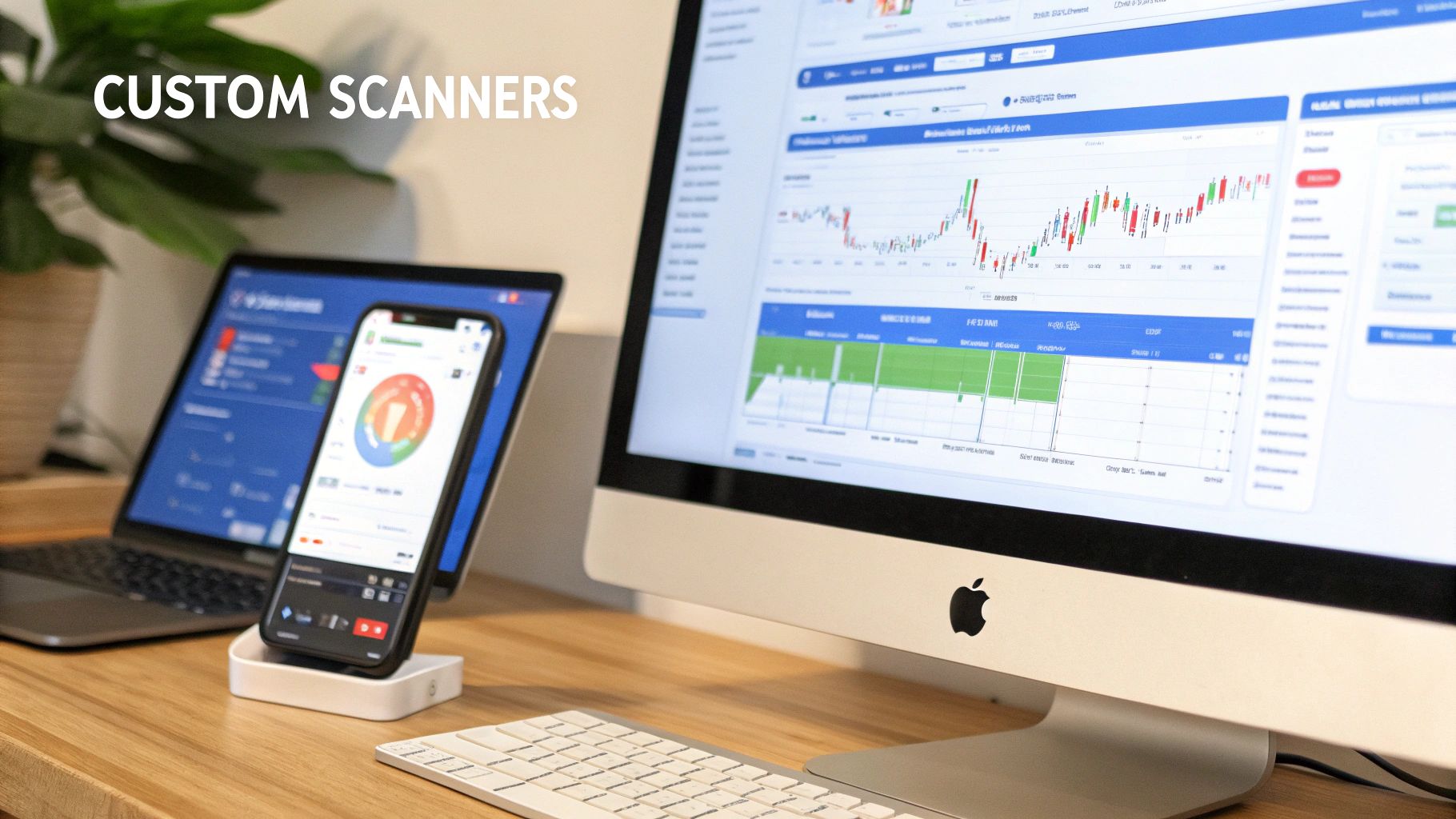
The real magic is in automation. Instead of manually sifting through hundreds of stocks looking for a setup, you can build custom scanners in ChartsWatcher that do all the heavy lifting for you. These scanners constantly churn through the market to find the handful of stocks that meet your precise criteria for an extended-hours trade.
It's like setting a highly specific trap. You define exactly what you're hunting for, and the scanner alerts you the moment it appears. For anyone looking to get serious about this, our guide on real-time stock scanning is a great place to get started.
To give you a better idea, here are a few practical examples of scanner settings designed specifically for finding opportunities outside of regular market hours.
ChartsWatcher Filters for Extended Hours Trading
This table shows a few starter recipes for building scanners that can pinpoint interesting activity during the pre-market and after-hours sessions.
| Strategy Goal | Recommended ChartsWatcher Filter | Why It Works |
|---|---|---|
| Find High-Momentum Gappers | Pre-Market Volume > 100,000 AND Price Change % > 5% | This isolates stocks with real institutional interest before the bell. The high volume confirms the move has power behind it, filtering out the low-volume head fakes. |
| Identify Earnings Reactors | After-Hours Volume > 5x Average AND Relative Volume > 3 | This finds stocks trading with unusually high volume after the market closes, a classic sign of a strong reaction to an earnings report or other big news. |
| Spot Potential Reversals | Price < 20-Day Avg AND Pre-Market Change % > 10% | This combination looks for beaten-down stocks showing a sudden burst of life in the pre-market, often signaling a potential bottom or a sharp trend reversal. |
These are just templates, of course. The real power comes when you start tweaking and customizing these filters to perfectly match your own trading style, letting the technology surface the exact setups you're looking for.
Using Alerts and Backtesting for a Sharper Edge
Once your scanners are humming along, you need to be notified instantly. ChartsWatcher lets you set up real-time alerts for critical events, like a huge spike in volume or a stock breaking through a key price level. You can get these alerts on your desktop or phone, so you never miss an opportunity, even if you step away from your desk.
The ultimate test of any strategy is seeing how it would have performed in the past. This isn't about predicting the future; it's about validating your process and building confidence in your rules.
Finally, a truly professional approach means validating your ideas before you risk a dime. ChartsWatcher’s backtesting feature lets you take the strategies and scanner settings we've talked about and run them against historical data. You can see exactly how a "gap and go" strategy based on a 5% pre-market move would have performed over the last year. This allows you to fine-tune your rules and understand your risk before you ever put real capital on the line. This is how you stop guessing and start making data-driven decisions.
Your Blueprint for the 24-Hour Market
The days when trading was confined to the sound of an opening and closing bell are long gone. Extended trading hours aren't some niche frontier for specialists anymore; they're a permanent and growing part of the market you need to understand.
Success out here isn't about taking wild guesses in the pre-market twilight. It's a discipline, one built on a healthy respect for the unique dynamics at play—the thin liquidity, the wide spreads, and the sudden, sharp bursts of volatility. It demands a real strategy, whether you're reacting to an earnings surprise or playing a pre-market gap.
More than anything, it hinges on your ability to use the right technology to see what everyone else is missing. The right tools can turn a chaotic flood of after-hours data into a clear, actionable advantage. This guide laid out the framework, but now the execution is in your hands.
Armed with a clear understanding of the risks and the powerful scanning, alerting, and backtesting tools from a platform like ChartsWatcher, you’re ready to step into this 24-hour market with confidence.
The best opportunities don't always wait for the 9:30 AM bell, and neither should you. The blueprint is right here. It's time to build your edge and start capitalizing on the moves happening outside the traditional trading day. The market is always on; your strategy should be, too.
Of course. Here is the rewritten section, crafted to sound like an experienced human expert, following all the provided guidelines.
Common Questions About Extended Hours Trading
Even after getting the hang of the strategies and risks, a few practical questions always pop up when traders first step into the pre-market or after-hours arena. Let's tackle some of the most common ones to clear up any lingering confusion and solidify the core concepts.
Can I Trade Any Stock I Want During These Hours?
Not quite. You’ll find that most trading outside the main session is concentrated in the big names—think large-cap stocks on the NYSE and Nasdaq.
Many smaller stocks, over-the-counter (OTC) securities, and even some niche ETFs simply don't have enough interest to trade outside of the 9:30 AM to 4:00 PM EST window. Whether a stock is available comes down to the exchanges and the electronic communication networks (ECNs) that actually match the buyers and sellers.
What Are the Top Risks I Really Need to Worry About?
We've touched on the dangers, but it pays to hammer home the top three that every single trader needs to respect.
- Thin Liquidity: This is the big one, the source of most problems. With fewer buyers and sellers, it can be a real struggle to get your orders filled at a decent price, often leading to nasty slippage.
- Wild Volatility: Prices can whip around violently on just a handful of shares, painting a completely false picture of a stock's true strength or weakness. This is how you get suckered into false breakouts and blindsided by sharp reversals.
- Wide Bid-Ask Spreads: The gap between the buying and selling price can get incredibly wide. This acts like an immediate, invisible tax on every trade you make, making it that much harder to end up in the green.
The most critical thing to remember is this: the price you see in the pre-market is often a mirage. It's not a reliable indicator of where the stock will actually trade once the opening bell rings and the institutional money floods in. Always treat those early prices with a healthy dose of skepticism.
Why is Everyone So Obsessed with Limit Orders After Hours?
Using a limit order is probably the single most important rule for protecting your capital in extended hours. A limit order is simple: it lets you set the exact price you're willing to pay or accept.
In a low-liquidity environment, throwing a market order out there is like playing with fire. A market order just says, "get me in at the next available price," and with huge spreads and a shallow order book, that "next price" could be miles away from what you expected. Limit orders are your safety net, ensuring you never pay more or sell for less than the price you choose.
How Much Does News from Overseas Markets Really Matter?
In today's world, global markets are completely intertwined. A major economic report out of Asia or a surprise policy announcement from a European central bank can ripple through U.S. markets instantly, and the pre-market is where we see the first tremors.
For instance, if a key Asian index tanks overnight, you'll almost certainly see U.S. index futures and related ETFs open lower in the pre-market. Experienced traders watch this like a hawk to gauge sentiment and get positioned before the chaos of the U.S. open. This makes international news an absolutely critical piece of the puzzle for any early-morning trading plan.
Ready to stop guessing and start making data-driven decisions in any market session? ChartsWatcher provides the powerful scanning, real-time alerts, and backtesting tools you need to find your edge. Build your blueprint for the 24-hour market at https://chartswatcher.com.