
Insights from ChartsWatcher
A Trader's Guide to the Liquidity of a Stock
When someone talks about a stock's liquidity, they're really just asking a simple question: How fast can I buy or sell it without wrecking the price? If a stock is highly liquid, it means there’s a crowd of buyers and sellers at all times, making transactions smooth and stable. It’s a key vital sign of a healthy, tradable stock.
Unpacking Stock Liquidity and Why It Matters
Think of it like this. Imagine you're at a bustling farmer's market trying to sell a basket of common apples. People are walking by constantly, and many are ready to buy. You can sell your apples quickly at the going rate. That’s high liquidity.
Now, picture trying to sell a rare, exotic fruit only a handful of people have even heard of. You could be waiting hours, maybe even days, just to find one interested person. And when you do, you might have to slash your price to close the deal. That’s low liquidity.
The stock market works on the same principle. A stock's liquidity is all about how efficiently you can turn your shares back into cash. It's the grease in the gears of the market, ensuring things run smoothly, fairly, and predictably.
The Core Benefits of High Liquidity
For any trader, paying attention to liquidity isn't just a technical footnote—it's a core piece of risk management and strategy. Highly liquid stocks bring some serious advantages to the table that can directly pad your bottom line and give you some peace of mind.
- Reduced Risk: Liquid markets are just plain more stable. With a huge pool of buyers and sellers, a single large trade isn't going to send the price into a nosedive or a rocket launch. This "market depth" acts as a buffer against wild, unpredictable swings.
- Lower Transaction Costs: A classic sign of good liquidity is a tight bid-ask spread. That's the tiny gap between the highest price a buyer is willing to pay (the bid) and the lowest price a seller will take (the ask). For liquid stocks, this spread is often just pennies, meaning you aren't "leaking" money every time you enter or exit a trade.
- Reliable Trade Execution: When you hit the "buy" button on a liquid stock, you can be pretty confident your order will fill at or very near the price you see on the screen. This minimizes slippage—the frustrating and costly difference between the price you expected and the price you actually got.
A liquid market is an efficient market. It's what allows traders to get in and out of positions with precision, turning a well-laid plan into a real-world profit without getting chewed up by bad execution or wide spreads.
Before we move on, let's break down the practical differences in a simple table. This makes it easy to see what you're dealing with when you compare a market giant to a small, obscure company.
High Liquidity vs. Low Liquidity Stocks at a Glance
| Characteristic | High-Liquidity Stock (e.g., AAPL) | Low-Liquidity Stock (e.g., Small-Cap Penny Stock) |
|---|---|---|
| Trading Volume | Very high (millions of shares daily) | Very low (thousands, or even hundreds, of shares daily) |
| Bid-Ask Spread | Extremely narrow, often a penny or two | Wide, can be several percentage points |
| Slippage | Minimal; orders fill at or near the quoted price | Significant; execution price can be far from expected price |
| Price Stability | More stable and less prone to sudden, large gaps | Volatile; can experience sharp price swings on small trades |
| Ease of Trading | Easy to enter and exit large positions quickly | Difficult to trade significant size without moving the price |
| Trader Type | Ideal for day traders, swing traders, and institutions | Suited for long-term investors who don't need quick exits |
Ultimately, understanding liquidity is the first real step toward becoming a proactive trader instead of a reactive one. It gives you the power to see beyond the price chart and judge the actual health and tradability of a stock.
Ignoring it is like trying to merge onto a busy highway with your eyes closed. Sure, you might get lucky, but you're taking on a massive, unnecessary risk. By making liquid stocks a priority, you're building your entire trading approach on a much more solid and strategic foundation.
How Traders Measure Stock Liquidity
Knowing liquidity is important is one thing; actually measuring it is another game entirely. Traders don't just go on gut feelings. They use a specific set of metrics to take the market's pulse and figure out if a stock is genuinely tradable.
Each metric gives you a different window into how easily a stock can be bought or sold. These aren't just abstract numbers on a screen—they're direct signals about market interest, how much it'll cost you to trade, and the stock's underlying stability. Learning to read them is key to spotting good opportunities and avoiding the hidden traps of illiquid stocks.
Trading Volume: The Foundational Metric
The most straightforward way to gauge a stock's liquidity is its trading volume. This simply tells you how many shares changed hands over a certain period, usually a single day. High volume means there’s a crowd of active buyers and sellers.
Think of it like the foot traffic in a store. A shop with thousands of customers daily (high volume) is a bustling hub where deals happen constantly. On the other hand, a quiet shop with only a few visitors (low volume) is a much slower place to make a sale.
For traders, the average daily trading volume (ADTV) is a crucial benchmark. Stocks that trade millions of shares every day are generally seen as highly liquid, making them a good fit for strategies that need quick entries and exits.
This mind map clearly shows how liquidity directly helps traders by cutting down risk, tightening spreads, and allowing for much faster trade execution.
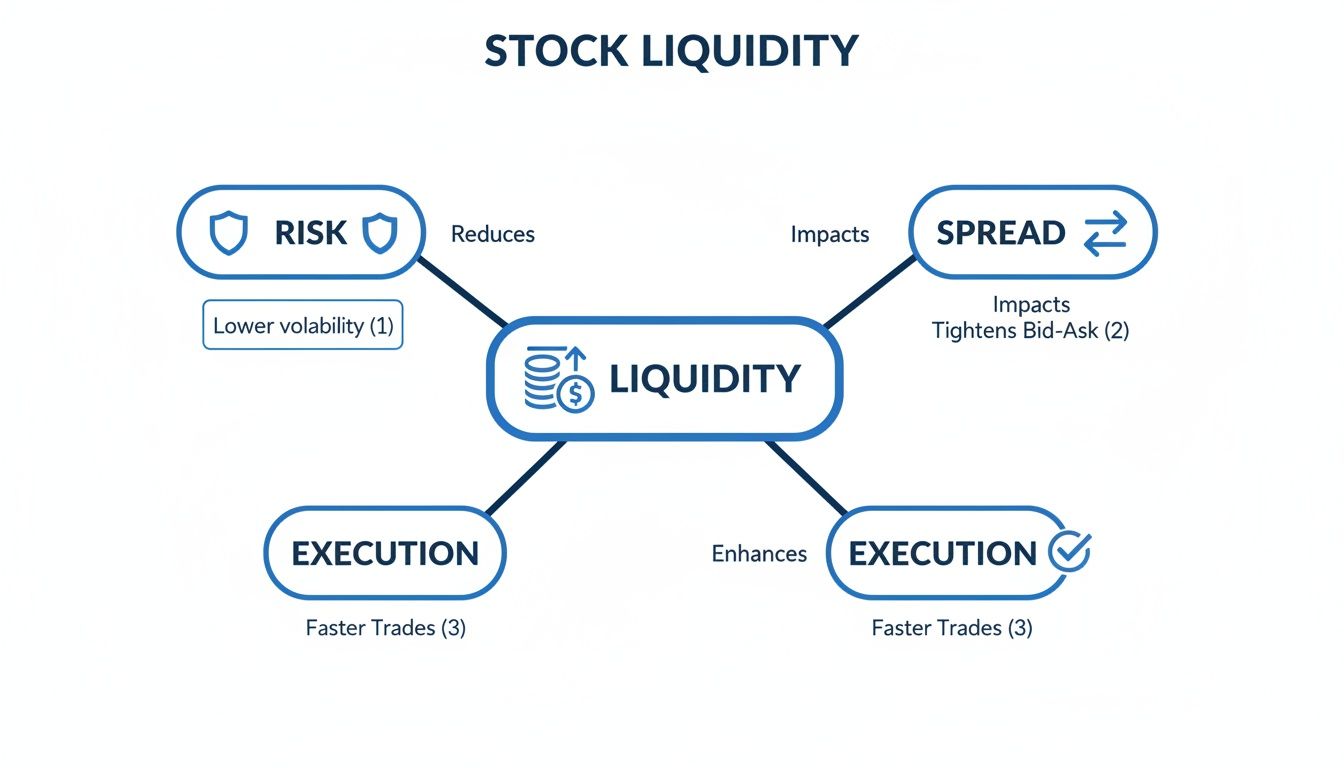
As you can see, these three pillars—risk management, cost efficiency, and reliable execution—are all direct results of a healthy, liquid market.
The Bid-Ask Spread: A Direct Transaction Cost
While volume shows you the level of interest in a stock, the bid-ask spread reveals the immediate cost of placing a trade. It’s the gap between the highest price a buyer is willing to pay (the bid) and the lowest price a seller is willing to accept (the ask).
A narrow spread is the hallmark of a liquid stock. It tells you there's fierce competition between buyers and sellers, which drives the prices closer together.
For instance, a massive-volume stock like Microsoft (MSFT) might have a bid of $450.50 and an ask of $450.51—a tiny one-cent spread. But an illiquid small-cap stock could have a bid of $5.25 and an ask of $5.50, a 25-cent spread. If you tried to day trade that stock, you'd instantly lose nearly 5% just to get in and out of the position. For a deeper dive on this, you can learn more about how to read bid and ask size to master market liquidity.
Order Book Depth: The Hidden Support
Going beyond what’s immediately visible, the order book depth gives you a crucial peek at the underlying stability of a stock's price. It shows you the volume of open buy and sell orders sitting at different price levels away from the current market price.
A deep order book has substantial orders stacked up, ready to soak up large trades. This depth acts like a shock absorber. If a stock has a deep book, a massive sell order won't send the price crashing because there are plenty of buy orders at slightly lower prices ready to step in. This is a huge reason why liquidity is so vital for institutional traders trying to move big positions without spooking the market.
Stock Turnover Rate: How Often Shares Move
Finally, the turnover rate offers a different angle by measuring how often a company's shares change hands relative to its total shares outstanding. You calculate it by dividing the total shares traded over a period by the total number of available shares.
A high turnover rate suggests that a stock is being actively traded by short-term players, not just sitting in the portfolios of long-term investors. It's a great way to confirm that a stock's high volume isn't just a one-off event but a consistent feature of its personality.
What Causes Stock Liquidity to Change?
A stock’s liquidity isn't set in stone. It’s more like the tide—constantly shifting, driven by a powerful mix of news, market sentiment, and the actions of major players. What’s a bustling hub of activity one day can become a ghost town the next.
Think of a stock as a busy public square. On a normal day, there’s a steady flow of people coming and going. But if something big happens in the middle of that square—like a surprise announcement or a major event—it can instantly draw a massive crowd, creating a surge of activity.
That's exactly how market-moving news jolts a stock’s liquidity. Scheduled events like quarterly earnings reports, Federal Reserve interest rate decisions, or major economic data releases can flood a specific stock or the entire market with trading volume. Traders and algorithms alike jump in to react, drastically increasing the number of buyers and sellers.
The Influence of News and Market Sentiment
Sudden, unscheduled news can have an even more explosive effect. A surprise product recall, a major lawsuit, or an unexpected merger announcement can trigger an immediate and massive spike in trading activity, boosting liquidity in a matter of minutes.
On the flip side, periods of high uncertainty can cause liquidity to evaporate. If traders are fearful or unsure about a company's future, they tend to pull their orders and step away. This creates a vacuum where both buyers and sellers become scarce, spreads widen, and it becomes dangerous to trade.
Think of it this way: liquidity is confidence made visible. When confidence is high and information is flowing, traders participate freely. When fear takes over and the future is murky, that participation dries up fast.
This creates a powerful feedback loop. High liquidity often attracts more traders, which in turn creates even more liquidity. In contrast, when liquidity starts to dry up, it can scare away participants, causing it to fall even further.
The Role of Different Market Participants
The ecosystem of the market is another critical driver. Different types of traders and institutions play distinct roles in either providing liquidity or soaking it up.
-
Market Makers and High-Frequency Traders (HFTs): These are the professional liquidity providers. Their business model is built on constantly placing both buy and sell orders, profiting from the tiny difference in the bid-ask spread. Their automated strategies ensure there are almost always orders available for popular stocks, keeping spreads tight and trading smooth.
-
Institutional Investors: Large players like pension funds, mutual funds, and hedge funds are often liquidity consumers. When they need to buy or sell a massive block of shares, their huge orders can absorb all the available liquidity at a certain price level, potentially causing significant price moves if not executed carefully.
-
Retail Traders: The growing force of individual investors collectively adds a tremendous amount of trading volume to the market. While a single retail trade is small, millions of them acting around the same news or trend can create powerful currents of liquidity.
The evolution of market structure itself has had a profound impact. The rise of electronic trading platforms, for example, completely transformed how assets are traded. The U.S. Treasury market offers a stunning case study: before modern electronic platforms, daily trading volume for the benchmark 10-year Treasury note was around $4-5 billion. After these systems took over, that figure exploded to over $22 billion—a massive increase that made it far easier to execute large trades. You can explore the full research on how technology reshaped market liquidity to see the data for yourself.
Understanding these forces helps you anticipate changes in a stock's tradability. A stock that is liquid today might not be tomorrow if a major news event shifts market sentiment or key institutional players finish executing their large orders. By paying attention to these drivers, you can better navigate the ever-changing waters of market liquidity.
Matching Liquidity to Your Trading Strategy
There’s no magic number for "good" stock liquidity. The right profile is completely tied to your personal trading style, your holding period, and how much risk you're comfortable with. What one trader sees as a golden opportunity, another will see as a reckless gamble.
This is critical: you have to align your stock picks with your strategy. A day trader trying to scalp an illiquid stock is like a Formula 1 driver showing up to a race in a cargo truck. The equipment just doesn't fit the job.
So, before you even pull up a chart, you need to have a firm grasp of what kind of liquidity your strategy needs to survive and thrive. Let's break down how different types of traders look at this.
High-Frequency and Day Trading High Liquidity Needs
For scalpers and day traders, high liquidity isn't just nice to have—it's everything. Their entire game is built on capturing tiny, fleeting price moves, often jumping in and out of a trade in minutes or even seconds. This style is only possible in the market's most liquid names.
Here’s why high liquidity is their lifeblood:
- Minimal Spreads: When you're trying to profit a few cents at a time, a wide bid-ask spread can turn a winning trade into a loser before you even get started. The most liquid stocks have razor-thin spreads, keeping transaction costs almost negligible.
- Instant Execution: These traders can't afford to wait. They need to get in and out at the exact price they see on the screen, and high liquidity ensures their orders get filled instantly without slippage.
- Capacity for Size: The heavy trading volume allows them to move in and out with larger positions without being the one to push the price around. This is a huge factor for professionals managing serious capital.
Swing Trading and Long-Term Investing A Broader View
Swing traders and long-term investors play a different game entirely, which changes how they think about liquidity. While they still need to steer clear of dangerously illiquid stocks, they don’t require the breakneck liquidity that a day trader does.
Swing traders, who might hold a position for several days or weeks, can handle slightly wider spreads and a bit more patience on their fills. In fact, they can sometimes find fantastic setups in moderately liquid stocks that haven't hit the radar of the high-frequency crowd yet. These mid-tier stocks often provide smoother, more sustainable trends.
Long-term investors can wander even further down the liquidity path. They might be hunting for undervalued companies with great fundamentals that just don't have a lot of daily trading volume. Their plan is to hold for months or years, so the immediate cost of getting in is far less important than the company's long-term growth potential. Sometimes, that very illiquidity is what's hiding an inefficiently priced gem.
Institutional Trading The Liquidity Challenge
For the big players—the institutional traders managing massive pension and mutual funds—liquidity is a completely different beast. Their orders are so enormous that they can single-handedly disrupt the market if they aren't careful. Dropping a massive buy order all at once would send the stock price soaring, wrecking their average entry cost.
For institutions, liquidity isn't just about getting a trade filled. It's about being able to move millions of shares without tipping off the market or causing a major price impact. They rely on sophisticated algorithms to slice their huge orders into tiny, manageable pieces over hours or even days.
This is where advanced market metrics become crucial. Data from sources like the NYSE gives these pros deep insight into how easily stocks in major indices like the S&P 500 can be traded without causing ripples. Tight spreads in large-cap stocks signal a healthy, robust market, whereas widening spreads in mid-caps can be an early warning sign. You can see how professionals track U.S. equity market liquidity with daily statistics on NYSE.com to get a sense of this high-level analysis. For them, managing liquidity is just as important as picking the right stock.
How to Screen for Liquid Stocks with ChartsWatcher
Knowing the theory behind stock liquidity is great, but turning that knowledge into real-world trading decisions is where the money is made. This is where a powerful stock screener like ChartsWatcher becomes your best friend. It lets you slice and dice through thousands of stocks in seconds, pulling out only the ones that perfectly fit your liquidity needs.
Instead of getting bogged down checking volume and spreads stock by stock, you can build a system. This puts the grunt work on autopilot, freeing you up to analyze high-quality, tradable opportunities that actually fit your strategy.
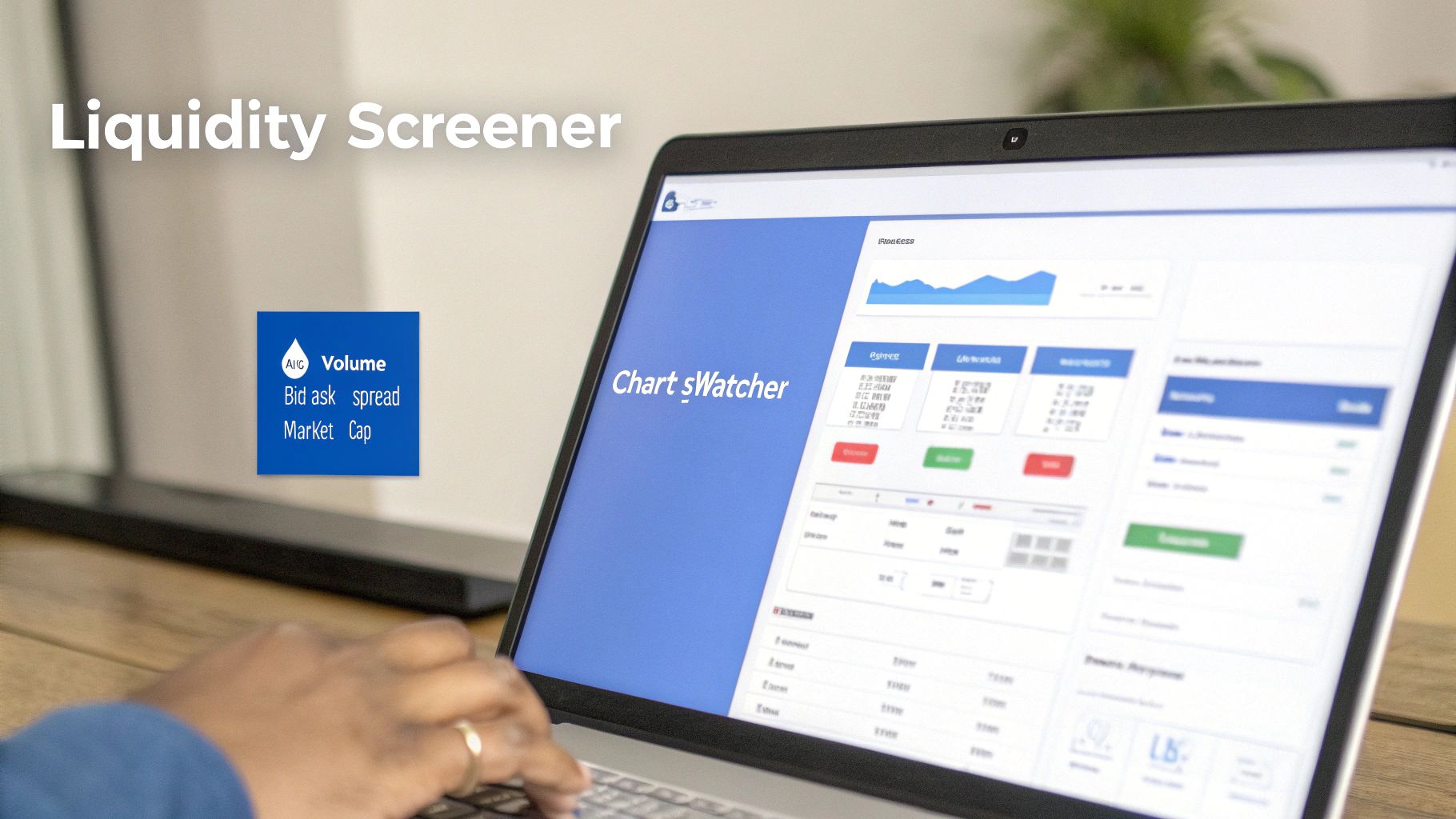
A personalized dashboard like this lets you keep tabs on key liquidity metrics across all your watchlists in real-time. It’s all about turning that abstract data into a clear visual edge.
Building Your Custom Liquidity Screener
Setting up a screener in ChartsWatcher is pretty straightforward. You're basically just stacking different filters on top of each other to shrink the entire market down to a manageable list of stocks worth your time. For liquidity, three filters are the bedrock of any solid screen.
Here are the must-haves for your setup:
-
Minimum Average Daily Volume (ADV): Think of this as your first line of defense against illiquid stocks. By setting a minimum ADV, you guarantee you’re only looking at stocks with consistent, real interest from other traders. A good starting point for active traders is 500,000 shares a day, but many pros won't touch anything under 1 million.
-
Maximum Bid-Ask Spread: You have to keep your trading costs down, and that means ditching stocks with wide spreads. In ChartsWatcher, you can filter this out by a percentage or a fixed dollar amount. For example, you could set a rule to only show stocks where the spread is less than 0.5% of the share price. This simple step ensures you aren’t bleeding profit to slippage every time you get in and out of a trade.
-
Specific Market Capitalization: Market cap and liquidity often go hand-in-hand. Large-cap stocks (over $10 billion) are typically swimming in liquidity, while small-caps can be much thinner. Filtering by market cap helps you zero in on the part of the market that matches your personal risk tolerance and trading style.
If you want to dive deeper into building effective scans, check out a guide to using a stock screener for swing trading for more hands-on tips.
Setting Up Real-Time Liquidity Alerts
Screening is fantastic for finding those initial ideas, but the market doesn’t sit still. A stock's liquidity can evaporate in an instant. This is exactly why setting up real-time alerts in ChartsWatcher is such a game-changer, especially for active traders.
Instead of being chained to your desk, you can have the platform ping you when something important happens. It’s a proactive approach that lets you react fast when conditions change.
An alert for a massive volume spike in a sleepy stock could be the first sign of a huge news catalyst or a breakout in the making. On the flip side, an alert for a widening spread can be a critical warning that liquidity is drying up and risk is climbing.
Here are a few high-impact alerts to consider setting up:
- Volume Spike Alert: Get a notification when a stock's volume blows past its 30-day average by a huge margin (like 500%).
- Spread Blowout Alert: Receive an alert if the bid-ask spread on a stock you’re watching suddenly widens beyond your acceptable limit.
- Block Trade Alert: Keep an eye out for unusually large trades. These can signal that big institutions are making moves, often right before a significant price swing.
By combining a custom-built screener with a smart set of real-time alerts, you create a complete system for mastering the liquidity of a stock. You can explore these features and more with the ChartsWatcher stock scanner. This turns a complex concept into a practical tool, giving you a tangible and repeatable advantage in the market.
Putting It All Together: Your Edge in the Market
Getting a real handle on a stock's liquidity does more than just give you another data point—it fundamentally changes how you see the market. You stop being a passive observer, simply reacting to price swings, and start acting like a strategic operator.
We've covered a lot, but the core idea is simple: liquidity isn't some abstract concept for academics. It's the lifeblood of a tradable stock. It's the difference between cruising down a six-lane highway and finding yourself stuck on a single-track dirt road with no way to turn around.
By weaving liquidity analysis into your daily routine, you begin to see beyond the candlestick charts. You start to feel the market’s pulse.
From Knowledge to Action
The real advantage kicks in when you make liquidity analysis a non-negotiable part of your trading process. It's about systematically filtering out the junk and focusing only on stocks that meet your personal standards for tradability. A chart pattern might look absolutely perfect, but if the stock is illiquid, trying to trade it can be a frustrating and expensive mistake.
This is where the right tools become your best friend. You build a lasting edge for yourself by:
- Screening for stocks with solid average daily volume and consistently tight bid-ask spreads.
- Monitoring for any sudden shifts in market depth that might hint at a change in sentiment.
- Alerting yourself to big volume spikes or spreads that blow out, which can signal either a new opportunity or a serious risk.
The big takeaway is this: stop looking at just charts and prices. When you add liquidity analysis to your toolkit, you gain a much deeper, more complete picture of the market. That's what leads to smarter and more confident trading.
A platform like ChartsWatcher is built to help you automate this entire workflow. You can set up a personalized dashboard that puts these vital liquidity metrics front and center, turning all that raw data into a clear, actionable advantage.
Ultimately, it’s about building a repeatable system that stacks the odds in your favor. It ensures you only step into markets where you can execute your strategy cleanly and without friction. This disciplined approach is what truly separates the consistently profitable traders from everyone else.
Got Questions About Stock Liquidity?
As you dig into liquidity, a few common questions always seem to pop up. Let's tackle some of the ones I hear most often from traders to make sure these key ideas are crystal clear.
Can a Profitable Company Have a Stock with Low Liquidity?
You bet. It happens all the time. A company's profitability speaks to how well the business is run—it’s a fundamental measure of health. Stock liquidity, on the other hand, is purely a market dynamic that reflects how easily its shares trade. The two don't always go hand-in-hand.
Think about a small, successful local company. It might be cranking out profits year after year, but if it flies under the radar of big Wall Street funds and day traders, nobody is really trading the stock. That lack of attention means low daily volume and a painfully wide bid-ask spread, making the stock illiquid even though the business itself is rock-solid.
How Does Stock Liquidity Affect Options Trading?
The connection here is huge. For options traders, the liquidity of the underlying stock is everything. A liquid stock almost always creates a healthier, more active options market.
When the underlying stock trades heavily, it brings a few massive advantages to the options on that stock:
- Tighter Spreads: The gap between the bid and ask prices on the options contracts themselves shrinks, which means you're not losing as much money to friction on every trade.
- More Choices: You’ll find a much wider selection of strike prices and expiration dates, giving you the flexibility to build the exact strategy you want.
- Higher Volume: With more people trading the options, it's way easier to get in and out of your positions quickly without your order knocking the price around.
Simply put, high stock liquidity is the foundation of an efficient and trader-friendly options market.
What Is the First Step to Analyze a Stock's Liquidity?
I tell every trader to start with a quick and dirty three-step check. It only takes a minute and gives you a surprisingly accurate snapshot of a stock's real-world tradability.
First, pull up the average daily trading volume. You want to see a number in the millions. If it's down in the thousands, that’s a major red flag—proceed with extreme caution.
Next, look at the live bid-ask spread. On a liquid stock, this should be razor-thin, maybe just a penny or two. A wide spread is an instant warning sign that your transaction costs are going to be high.
Finally, take a peek at the Level 2 order book. You're looking for depth. A healthy book has thick stacks of buy and sell orders piled up right around the current price, which shows the stock can handle big trades without getting pushed around.
This simple process—checking volume, spread, and depth—is how you move from theory to practice. It's a repeatable gut check you should perform on any stock before you ever think about putting capital at risk.
Ready to turn these concepts into a real market edge? ChartsWatcher gives you the professional-grade screeners, real-time alerts, and dashboards you need to master liquidity analysis and find your next winning trade. Start your analysis today at https://chartswatcher.com.